In this article
- Why Your Building Needs a Written Strata Cleaning Checklist
- How to Read the Frequencies
- The Strata Cleaning Checklist, Area by Area
- Periodic and Deep-Clean Items in Your Strata Cleaning Checklist
- What Is Excluded From a Strata Cleaning Checklist?
- Add Reporting to Your Strata Cleaning Checklist
- 7 Common Mistakes When Writing a Strata Cleaning Checklist
- Safety Notes for Your Strata Cleaning Checklist
- How to Customise the Strata Cleaning Checklist for Your Building
- Example: A Strata Cleaning Checklist for a 24-Lot Building
- Using the Strata Cleaning Checklist in a Tender
- Onboarding a New Cleaner With Your Strata Cleaning Checklist
- Strata Cleaning Checklist FAQs
- Want a Cleaner Who Works to Your Checklist?
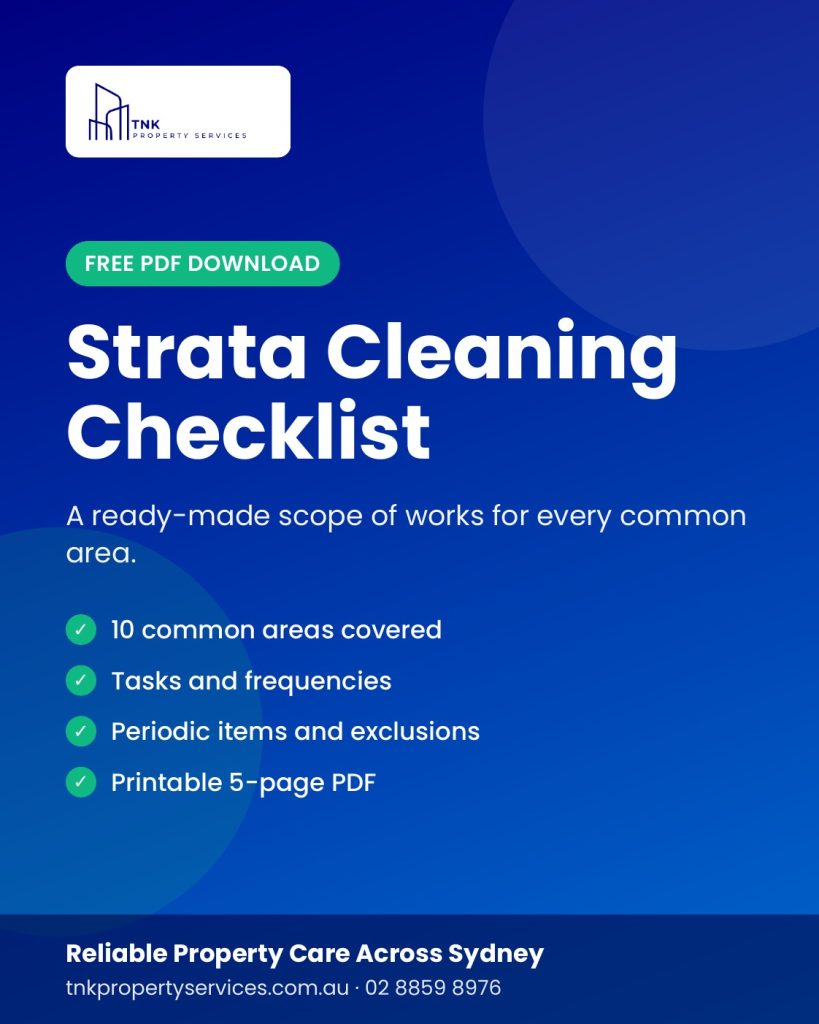
Quick answer: A strata cleaning checklist (also called a scope of works) lists every common area in your building, the cleaning tasks done in each one, how often each task happens, and what is excluded. Use the free strata cleaning checklist below, or download the printable PDF, and give the same copy to every cleaner so their quotes can be compared fairly.
Most disputes between committees and cleaners come down to one thing: nobody wrote down what “clean the common areas” actually means. A clear strata cleaning checklist fixes that. It sets expectations for residents, gives your cleaner a job list for every visit, and gives your strata manager something concrete to check against.
We are TNK Property Services. We have looked after strata buildings across Greater Sydney for more than ten years, and this is the same structure we use when we write a scope for a new building. Change the frequencies to suit your scheme, then use it in your next tender.
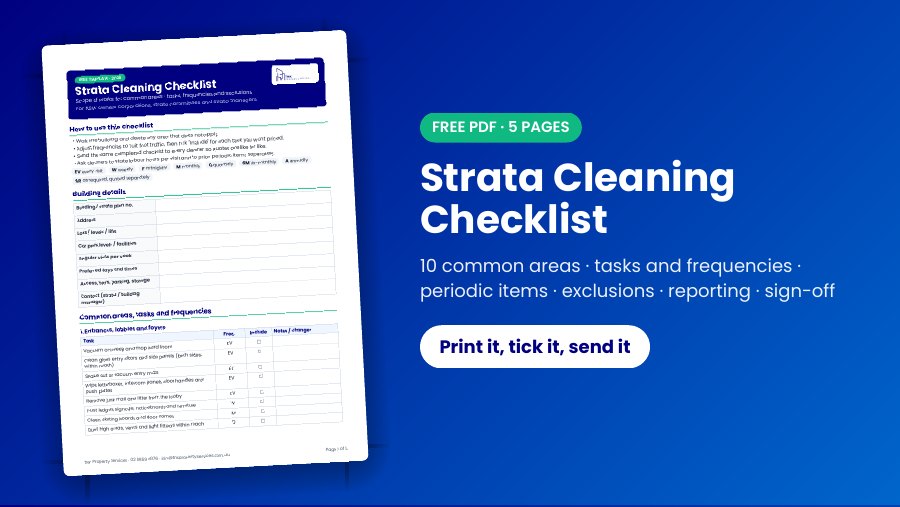
Download the free strata cleaning checklist (PDF)
In this checklist
- Why your building needs a written strata cleaning checklist
- How to read the frequencies
- The strata cleaning checklist, area by area
- Periodic and deep-clean items
- What is excluded
- Add reporting
- 7 common mistakes
- Safety notes
- How to customise the checklist for your building
- Example for a 24-lot building
- Using the checklist in a tender
- Onboarding a new cleaner
- FAQs
Why Your Building Needs a Written Strata Cleaning Checklist
Under the NSW strata repairs and maintenance rules, the owners corporation is responsible for common property. Keeping shared areas clean, safe and presentable is part of looking after that property, and a written strata cleaning checklist shows how your committee is doing it.
A good checklist helps your scheme in five ways:
- Fair quotes: every cleaner prices the same work, so you compare like with like.
- Clear expectations: residents, the committee and the cleaner all know what “done” looks like.
- Easy checking: your strata manager can audit visits against a list instead of opinions.
- Better budgets: periodic items are planned, not sprung on the committee mid-year.
- Proof for the AGM: paired with visit reports, it shows owners what their levies paid for.
How to Read the Frequencies
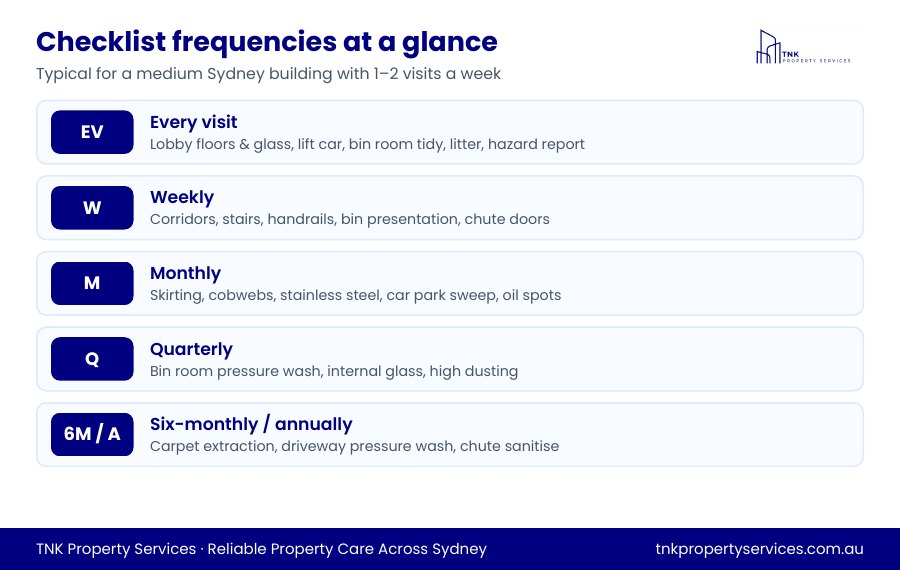
Each task in the strata cleaning checklist has a suggested frequency. These suit a typical medium-sized Sydney building with one or two visits a week. Smaller blocks may stretch some items out; busy towers will need more.
| Code | Meaning |
|---|---|
| EV | Every visit |
| W | Weekly |
| F | Fortnightly |
| M | Monthly |
| Q | Quarterly |
| 6M | Six-monthly |
| A | Annually |
| AR | As required, quoted separately |
The Strata Cleaning Checklist, Area by Area
Work through each area of your building and tick the tasks you want included. Delete anything that does not apply, such as a pool or gym.
1. Entrances, lobbies and foyers
| Task | Frequency |
|---|---|
| Vacuum or sweep and mop hard floors | EV |
| Clean glass entry doors and side panels (both sides, within reach) | EV |
| Shake out or vacuum entry mats | EV |
| Wipe letterboxes, intercom panels, door handles and push plates | EV |
| Remove junk mail and litter from the lobby | EV |
| Dust ledges, signage, noticeboards and furniture | W |
| Clean skirting boards and door frames | M |
| Dust high areas, vents and light fittings within reach | Q |
2. Lifts
| Task | Frequency |
|---|---|
| Vacuum or mop lift car floor | EV |
| Clean mirrors, walls and stainless steel panels | EV |
| Wipe call buttons and control panels | EV |
| Vacuum lift door tracks | W |
| Polish stainless steel landing doors on each floor | M |
3. Corridors, hallways and landings
| Task | Frequency |
|---|---|
| Vacuum carpets or sweep and mop hard floors | EV or W |
| Spot clean marks on walls, doors and lift landings | W |
| Wipe light switches, handrails and door handles | W |
| Dust skirting boards, ledges and fire hose reel cabinets (outside only) | M |
| Remove cobwebs within reach | M |
4. Stairwells and fire stairs
| Task | Frequency |
|---|---|
| Sweep stairs and landings, remove litter | W |
| Mop stairs and landings | F |
| Wipe handrails and balustrades | W |
| Report blocked exits, propped fire doors or blown lights | EV |
| Remove cobwebs and dust window sills within reach | M |
5. Bin rooms and waste areas
| Task | Frequency |
|---|---|
| Sweep and mop bin room floor | EV |
| Tidy bins, close lids, report overflowing bins | EV |
| Present bins for council collection and return them (if included) | W |
| Wash and deodorise bins | F or M |
| Clean garbage chute hopper doors on each floor | W |
| Report dumped bulky items and illegal dumping to the strata manager | EV |
| Pressure wash bin room floor and walls | Q |
6. Car parks, driveways and garages
| Task | Frequency |
|---|---|
| Litter pick-up and spot sweep | W |
| Sweep car park lift lobby and stair entries | W |
| Full car park sweep (manual or ride-on) | M or Q |
| Treat fresh oil spots | M |
| Clear leaves and litter from drainage grates within reach | M |
| Pressure wash driveway and ramps | 6M or A |
7. Common area glass and windows
| Task | Frequency |
|---|---|
| Spot clean fingerprints on internal glass | EV |
| Clean internal common area glass within reach | M |
| Clean reachable external ground-floor glass and shopfronts | M or Q |
| Clean glass balustrades in common areas | Q |
| High or external windows needing ladders, EWPs or rope access | AR |

8. Shared facilities: gym, pool surrounds, BBQ and rooftop
| Task | Frequency |
|---|---|
| Wipe gym equipment touch points, mirrors and benches | EV |
| Vacuum or mop gym floor | EV |
| Sweep pool surrounds and wipe outdoor furniture | W |
| Clean BBQ hotplates and surrounds (if included) | W |
| Sweep rooftop terraces and empty outdoor bins | W |
| Clean common area toilets and amenities, restock consumables | EV |
9. Mail, parcel and community rooms
| Task | Frequency |
|---|---|
| Sweep and mop floors, remove junk mail | EV |
| Wipe parcel lockers, tables and benches | W |
| Clean kitchenette sink and benches in community rooms | W |
10. External paths and grounds (cleaning only)
| Task | Frequency |
|---|---|
| Litter pick-up along paths and entries | EV |
| Sweep front paths, steps and entry porches | W |
| Clear cobwebs from entry soffits and external lights within reach | M |
| Pressure wash paths and entry paving | 6M or A |
Mowing, hedging and planting are garden tasks rather than cleaning tasks. If you want them under the same contract, add them as a separate section or ask about our garden maintenance service.
Periodic and Deep-Clean Items in Your Strata Cleaning Checklist
Periodic items are where budgets slip, so list them in your strata cleaning checklist by name and frequency, and ask each cleaner to price them separately.
| Periodic item | Suggested frequency |
|---|---|
| Hot water extraction of corridor and stair carpets | A or 6M |
| Hard floor machine scrub, strip and seal | A |
| Pressure wash driveways, paths, bin bays and pool surrounds | 6M to A |
| Full common area window clean, internal and external | Q to 6M |
| Garbage chute and hopper sanitise | A |
| High-level dusting, light diffusers and exhaust vents | 6M to A |
| Wall washing in high-traffic corridors | A |
TNK can plan these alongside your regular visits, including carpet cleaning and window cleaning, so they happen on schedule rather than when someone complains.
What Is Excluded From a Strata Cleaning Checklist?
Writing down exclusions is just as important as listing tasks. It stops “scope creep” and makes sure specialist work goes to the right contractor. A standard strata cleaning checklist usually excludes:
- Inside private lots: apartments, private balconies, courtyards and storage cages belong to owners, not the owners corporation.
- Work at height: external windows, facades, gutters and atriums that need ladders above a safe height, elevated work platforms or rope access. These are quoted separately with the right safety plan.
- Hazardous and biological waste: sharps, bodily fluids, asbestos, chemical spills and hoarding clean-ups need a specialist process.
- Bulky rubbish removal: dumped furniture and mattresses are usually arranged through council collection or quoted as ad hoc rubbish removal.
- Graffiti removal and pest control: handled as separate jobs.
- Trade work: plumbing, electrical, locksmith, lift and fire equipment servicing must be done by licensed trades.
- Repairs and replacements: broken tiles, carpets, door closers and light globes. Cleaners should report these, not fix them, unless maintenance is in the contract.
If you want one contractor to handle cleaning, repairs and trades together, look at a combined strata cleaning and maintenance agreement. That way the cleaner who spots a blown light or a leaking tap can log it and get it fixed.
Add Reporting to Your Strata Cleaning Checklist
A strata cleaning checklist tells the cleaner what to do. Reporting proves it was done. Without it, the committee only hears about cleaning when something is missed.
Ask your cleaner to provide, after every visit:
- The date, start time and finish time on site.
- Which checklist sections were completed, and anything skipped with a reason.
- Photos of key areas such as the lobby, lifts and bin room.
- Hazards and defects found, for example trip hazards, leaks, broken glass, blown lights or propped fire doors.
- Periodic items completed that month.
At TNK, our crews log tasks on site and send a photo-backed report as soon as the job is done. Committees can bring those reports to the AGM as proof of work.
7 Common Mistakes When Writing a Strata Cleaning Checklist
- Using vague wording. “Clean common areas” invites argument. Name each area and task.
- Leaving out frequencies. A task with no frequency tends to happen “sometimes”.
- Forgetting hidden areas. Bike rooms, car wash bays and fire stair landings are often missed.
- Bundling periodic items into the visit price. List them separately so you can see what they cost.
- No exclusions. If it is not written down, you may pay twice or not at all.
- No reporting requirement. You cannot manage what you cannot see.
- Never updating it. Review your strata cleaning checklist every year, and whenever the building changes.
Safety Notes for Your Strata Cleaning Checklist
Cleaning involves wet floors, chemicals, ladders and bins, so safety belongs in the scope. Ask cleaners to use wet floor signs, store chemicals securely and keep Safety Data Sheets for the products they use on site.
Work at height is a special case. In NSW, construction work with a risk of a person falling more than two metres is classed as high risk and needs a safe work method statement. Keep high windows, gutters and facades out of the regular strata cleaning checklist and quote them separately with the right safety documents.
SafeWork NSW explains when an owners corporation has work health and safety duties for common areas. In short, purely residential common areas are generally treated differently from mixed-use ones, and things change if the owners corporation employs a worker directly. Your cleaning contractor still has its own duties to its staff either way.
How to Customise the Strata Cleaning Checklist for Your Building
No two schemes are the same. Before you send the strata cleaning checklist out, spend 20 minutes adjusting it:
- Walk the building. List every common area, including hidden ones like car wash bays, bike rooms and plant room entries.
- Delete what does not apply. No pool, no gym, no lift? Remove those sections.
- Adjust frequencies to traffic. A 100-lot tower may need lobby floors done daily; a 6-lot walk-up may only need a fortnightly visit.
- Note access details. Keys, fobs, parking, water taps, power points and storage for equipment.
- Set visit times. Early morning avoids residents but can attract penalty rates. Tell cleaners your preferred window.
- Add reporting requirements. Ask for a visit log, photos of key areas and a hazard report.
- Agree how extras are approved. Who can authorise ad hoc work and up to what amount?
Suggested visit frequency by building size
| Building | Typical regular visits |
|---|---|
| Up to 12 lots, no lift | Weekly or fortnightly |
| 12 to 30 lots, one lift | 1 to 2 visits a week |
| 30 to 60 lots, basement and gardens | 2 to 3 visits a week |
| 60+ lots with facilities | 3 to 5 visits a week, or daily |
Example: A Strata Cleaning Checklist for a 24-Lot Building
To show how the pieces fit together, here is how a typical scope might look for a fictional four-storey, 24-lot building in Western Sydney with one lift, a basement car park, a bin room and a small front garden.
- Regular visits: one visit a week of about four to six hours, on a weekday morning.
- Every visit: lobby floors and glass, lift car, bin room sweep and tidy, litter pick-up, hazard report.
- Weekly: corridor vacuuming on all levels, stair sweep, handrails, bin presentation and return.
- Monthly: car park lift lobby and ramp sweep, skirting boards, cobwebs, stainless steel polish.
- Quarterly: bin room pressure wash, internal common area glass, high dusting within reach.
- Annually: carpet hot water extraction, driveway pressure wash, chute sanitise if fitted.
- Excluded: lots and balconies, work at height, bulky rubbish, trades.
That one-page summary, backed by the full strata cleaning checklist tables above, is enough for three cleaners to price the same job. It also tells new committee members exactly what the building is paying for.
Your own scheme will differ. A boutique six-lot block might need only a fortnightly visit, while a 150-lot tower could need a daily lobby clean plus a weekend touch-up. The structure stays the same: areas, tasks, frequencies and exclusions.
Using the Strata Cleaning Checklist in a Tender
The real power of a strata cleaning checklist is in quoting. When every cleaner prices the same tasks at the same frequencies, the differences between quotes become obvious: hours on site, rates, inclusions and paperwork.
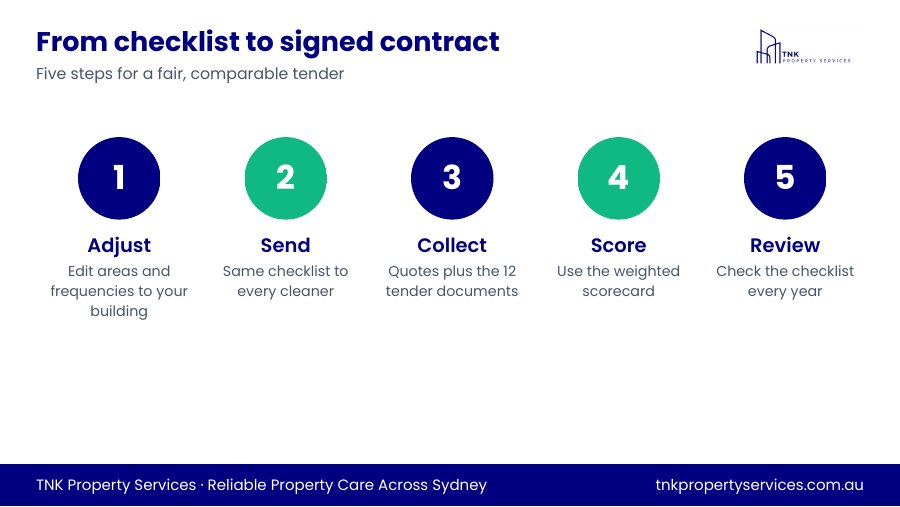
Here is the process we recommend:
- Finalise your checklist and attach it to your request for quote.
- Ask each cleaner to confirm hours per visit and price periodic items separately.
- Ask for the compliance documents in our strata cleaning tender pack, including insurance certificates and safety documents.
- Score the quotes with the free scorecard on that page.
- Check the prices against our Sydney strata cleaning cost guide to see if they sit within market ranges.
Once your new cleaner starts, keep the strata cleaning checklist on file and review it at least once a year. Buildings change: a new gym opens, a bin system changes, or a busy period shows a gap.
Onboarding a New Cleaner With Your Strata Cleaning Checklist
The first month with a new contractor sets the tone for the whole contract. Use your strata cleaning checklist to make the handover smooth:
- Walk the site together. Go through each area on the checklist with the cleaner and your building or strata manager.
- Hand over access. Record every key, fob and code issued, and who holds them.
- Agree the visit plan. Confirm the days, times and the order the areas will be cleaned.
- Set a baseline. Take photos of each area on day one so everyone can see the starting condition.
- Book a 30-day review. Check the first month of reports against the checklist and fix any gaps early.
A short review after the first month is far easier than a dispute after six. It also gives the cleaner a fair chance to adjust to your building.
Strata Cleaning Checklist FAQs
What is the difference between a strata cleaning checklist and a scope of works?
They are mostly the same thing. A scope of works is the formal version attached to a contract. A strata cleaning checklist is the practical list of areas, tasks and frequencies inside it. Our PDF works as both.
How often should strata common areas be cleaned?
Most small and medium Sydney buildings need one or two visits a week. Larger or high-traffic buildings often need three to five visits, or daily lobby cleaning. Frequency should match foot traffic, not just lot numbers.
Who should write the strata cleaning checklist?
Usually the strata manager or building manager drafts it with input from the committee. A good cleaner can also suggest changes after a site walk-through.
Should cleaners report maintenance issues?
Yes. Add a line to your strata cleaning checklist asking cleaners to report hazards, damage, blown lights and propped fire doors after every visit. It costs little and catches problems early.
Can we use this checklist for a commercial or mixed-use building?
Yes, with changes. Mixed-use buildings often need extra retail frontage, toilets and loading dock cleaning. Note that work health and safety duties can apply differently where common areas are used for commercial purposes, so check with your strata manager.
Is the PDF free to use?
Yes. Download it, mark up the tasks and frequencies to suit your building, and share it with any contractor you like. If you prefer a digital version, copy the tables on this page into your own document.
Want a Cleaner Who Works to Your Checklist?
TNK Property Services cleans strata buildings across Greater Sydney with ISO 9001:2015 certified systems, $20M public liability cover, police-checked staff and photo-backed reports for every visit. Send us your strata cleaning checklist, or use ours, and we will walk through your site and return a written scope and fixed price.