In this article
- Who Pays for Strata Repairs in NSW?
- What Counts as Common Property?
- Common Grey Areas in Strata Repairs
- Which Fund Pays for Strata Repairs?
- The Strata Repairs Process, Step by Step
- Emergency Strata Repairs
- 2025 Law Changes Your Committee Should Know
- What If a Strata Repair Is Not Fixed?
- Building Defects in Newer Buildings
- How to Keep Strata Repairs Small
- How TNK Helps With Strata Repairs
- Strata Repairs FAQs
- Get Help With Your Building’s Strata Repairs
Quick answer: In NSW, strata repairs to common property are the owners corporation’s job, and they are paid for from strata levies through the administrative fund or the capital works fund. Lot owners pay for repairs to anything inside their own lot, such as internal walls, carpet, fixtures and appliances. Common property usually covers the roof, gutters, boundary walls, the concrete slab, balconies, windows, shared pipes and common area lights. Your strata plan and by-laws decide the grey areas.
Most disputes come from the grey areas, like a leak that starts in one place and damages another. This guide covers who pays for what, which fund is used, how the repair process works, what the 2025 law changes mean for your committee, and what to do when a repair is ignored.
We are TNK Property Services, a Smithfield-based family business that has looked after Sydney properties for more than a decade. We wrote this for strata managers, owners corporation committees, building managers and owners who want clear answers before the next committee meeting.
In this guide
- Who pays for strata repairs in NSW?
- What counts as common property?
- Common grey areas in strata repairs
- Which fund pays for strata repairs?
- The strata repairs process, step by step
- Emergency strata repairs
- 2025 law changes your committee should know
- What if a repair is not fixed?
- Building defects in newer buildings
- How to keep strata repairs small
- Strata repairs FAQs
Who Pays for Strata Repairs in NSW?
The rule starts with section 106 of the Strata Schemes Management Act 2015. It says an owners corporation must properly maintain common property and keep it “in a state of good and serviceable repair”. It must also renew or replace common property fixtures and fittings when needed. Lot owners, in turn, look after their own lot.
The NSW Government’s strata repairs and maintenance guidance gives a helpful list of who is usually responsible. We have put it in the table below. Treat it as a general guide, because your own strata plan and by-laws can change the answer for your building.
| Usually the lot owner | Usually the owners corporation |
|---|---|
| Internal walls (not boundary walls) | Roof and gutters |
| Changes the owner made to the ceiling | Ceiling (except painting), unless the problem comes from owner changes |
| Carpet inside the lot | Carpets on common property, such as hallways |
| Internal painting and wallpaper | Boundary walls and the concrete slab (floor) |
| Lights that hang into the lot | Lights on common property and lights recessed into the ceiling |
| Plumbing in internal walls and fixtures (baths, toilets, sinks, showers) | Plumbing in boundary walls and under the floor |
| Water damage coming from inside the lot | Water damage coming from common property |
| Broken appliances and whitegoods | Balconies, balcony doors, windows and window locks |
| Window cleaning, unless it cannot be reached safely | Garage repairs |
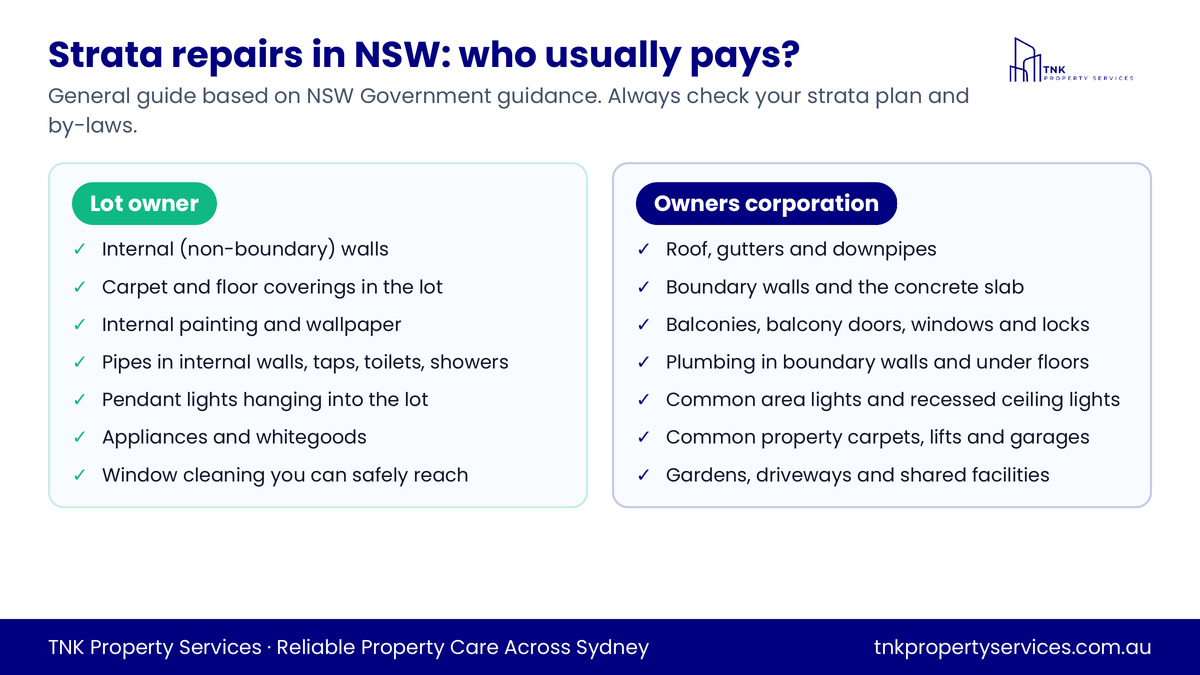
A simple way to remember it: if it is structural, shared, or sits on or inside a boundary, it is usually the owners corporation’s strata repair. If it is a finish, fitting or appliance inside your four walls, it is usually yours.
What Counts as Common Property?
Common property is generally any area that all residents use, plus anything of structural importance. NSW Government guidance lists examples such as entry foyers, hallways, stairs, lifts, driveways, pools, gardens, roofs, external walls, pipes and wiring, and shared services like hot water and ventilation.
The exact boundary between a lot and common property is drawn on your strata plan, and plans differ, so always check yours.
The common property memorandum
If your by-laws do not clearly say who is responsible for what, your scheme can pass a special resolution to adopt the NSW Government’s common property memorandum. This is a standard list of items that are and are not common property. Schemes can only remove items that do not apply to them (for example, a pool) or reflect existing common property by-laws. It is a quick way to end years of arguments about strata repairs.
By-laws that shift responsibility
A by-law can make a particular owner responsible for maintaining part of the common property. This is common when an owner has approval for a renovation, such as new bathroom waterproofing or a balcony enclosure. Under the Act, the owners corporation’s duty to maintain is subject to these by-laws, so read them before you decide who pays.
Common Grey Areas in Strata Repairs
These are the strata repairs we see cause the most debate in Sydney buildings. The answer often depends on where the problem starts, not where the damage shows.
Leaks and water damage
If water comes from a pipe inside an internal wall or from a fixture like a shower, the owner of that lot is usually responsible. If it comes from plumbing in a boundary wall, under the slab or from the roof, it is usually a common property repair. The NSW guidance gives the example of a leak from an upstairs bathroom running through the floor: because the plumbing sits in the boundary wall and floor, the owners corporation arranges the plumber.
Balconies, doors and windows
Balconies, balcony doors, windows and window locks are usually common property in NSW. Glass that has been broken by an owner or their tenant can be a different story, as the owners corporation may seek to recover the cost of damage someone caused.
Window cleaning
Owners usually clean their own windows, unless the glass cannot be reached safely, such as high external glass on a tower. Many committees add hard-to-reach glass to a scheduled contract. TNK’s window cleaning services can cover common area and hard-to-reach glass as part of your building’s program.
Which Fund Pays for Strata Repairs?
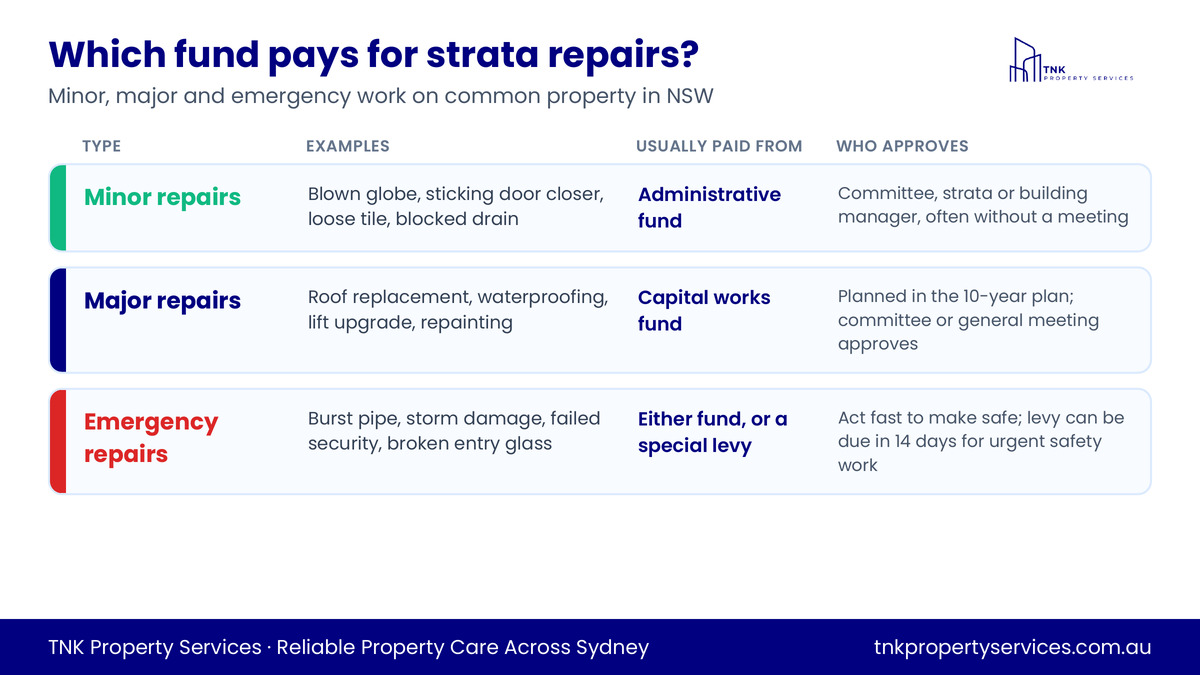
Every NSW owners corporation has two main funds, both filled by levies. Which one pays for strata repairs depends on the size and nature of the work.
| Type of repair | Examples | Usually paid from | Who usually approves |
|---|---|---|---|
| Minor repairs | Blown hallway globe, door closer, loose tile, blocked drain | Administrative fund | Strata committee, strata manager or building manager, often without a meeting |
| Major repairs | Roof replacement, waterproofing, lift upgrade, external repainting | Capital works fund (sinking fund) | Planned in the 10-year capital works plan, then approved by the committee or a general meeting |
| Emergency repairs | Burst pipe, storm or fire damage, failed security system, broken entry glass | Either fund, or a special levy | Make safe first, then follow your by-laws and spending limits |
The 10-year capital works plan
Every owners corporation must have a 10-year capital works plan that forecasts major repairs and their likely costs. New and revised plans must use the standard form, and NSW Fair Trading’s Strata Hub has a free capital works fund planner to help. The plan must be reviewed at least every five years. A realistic plan is the single best way to avoid surprise special levies for big strata repairs.
Levy notice periods
Owners must get written notice of levies with at least 30 days to pay. For emergency repairs needed to deal with a serious and imminent threat to residents’ health or safety, the notice period can be as short as 14 days.
The Strata Repairs Process, Step by Step
Whether the job is a squeaky fire door or a leaking roof, common property strata repairs follow the same basic path.
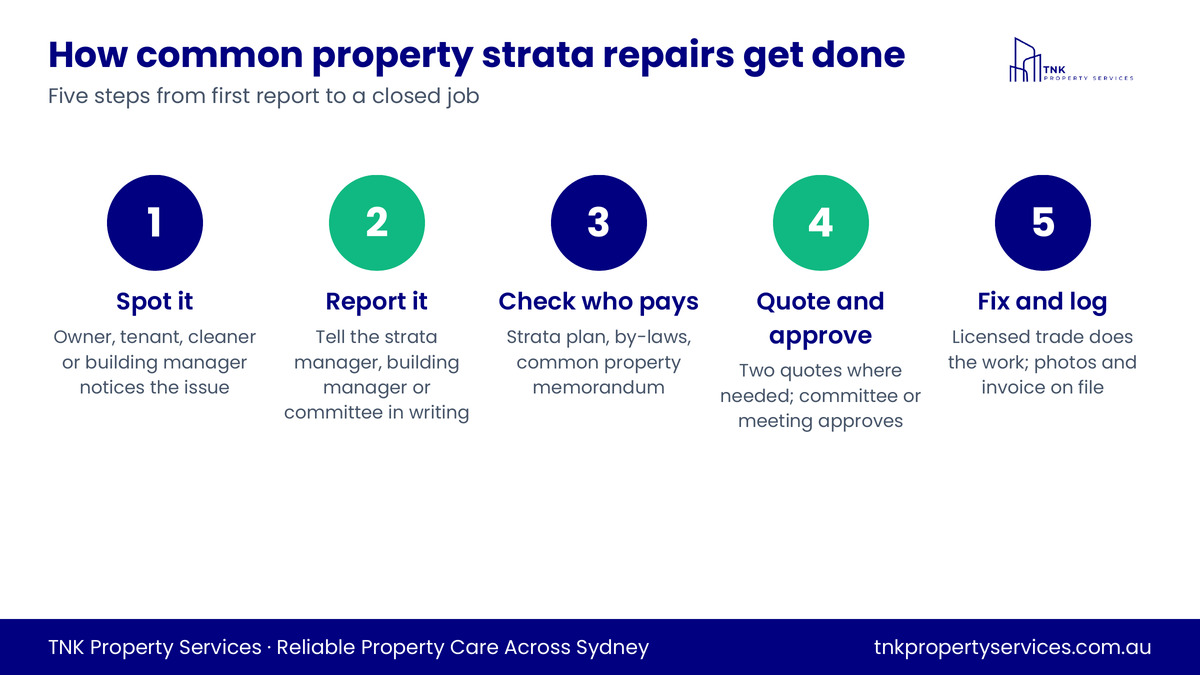
- Spot it. An owner, tenant, cleaner or building manager notices the problem. Tenants should report to their landlord or agent, who passes it on.
- Report it in writing. Email the strata manager, building manager or committee with photos, the exact location and when it started. A written record matters if the repair is later disputed.
- Check who pays. The strata manager checks the strata plan, by-laws and any common property memorandum. If it is the owner’s repair, they will tell you.
- Quote and approve. The owners corporation gets quotes and approves the preferred supplier within its spending limits. NSW guidance says to get at least two quotes, and all schemes must get at least two independent quotes for work valued at $30,000 or more (emergency work is excluded). Check each supplier is licensed, insured and uses the right type of contract.
- Fix and log. The work is done, checked against the quote and paid for. Keep photos, invoices and any warranty with the strata records.
Before you approve any contract, look for unfair terms, such as large fees to end the agreement. If you are tendering an ongoing contract rather than a one-off repair, our strata cleaning tender pack shows which insurance and safety documents to ask for, and the same checks work for maintenance contractors.
Emergency Strata Repairs
A burst pipe, storm damage, a failed security door or broken entry glass cannot wait for a meeting. Make the building safe and stop further damage first.
- Owners: tell the strata manager or a committee member straight away. Check your strata manager’s website for an emergency contractor list or protocol.
- If there is no list: NSW guidance says you can choose who to hire. If the problem turns out to be common property, you may be able to claim a refund from the owners corporation.
- Keep evidence: take photos and ask the tradesperson for written details of the cause and the fix. You may need to show the work was necessary and urgent.
Having a single contractor on call makes emergency strata repairs far less stressful. TNK offers 24/7 emergency response for leaks, breakages and safety hazards in common areas, as part of our strata cleaning and maintenance service.
2025 Law Changes Your Committee Should Know
NSW strata laws changed in 2025, and several changes affect strata repairs directly. According to the NSW Government’s guide to the changes:
- Fair Trading has new enforcement powers. It can investigate whether an owners corporation is meeting its duty to repair and maintain, and can seek an enforceable undertaking, issue a compliance notice, issue a penalty notice, or apply to the Tribunal for orders.
- Longer time to claim. Owners now have six years (up from two) to claim damages from the owners corporation for failing to maintain and repair common property.
- Delays have limits. An owners corporation suing someone for damage cannot delay strata repairs if the delay would affect safety or a person’s access to or use of the common property or a lot.
- Clearer responsibility for changes. When a special resolution changes common property, it must say whether the owners corporation or the lot owner will maintain it.
The takeaway: deferred maintenance is now a real compliance risk. A clear log of reported and completed strata repairs shows you are meeting your duty.
What If a Strata Repair Is Not Fixed?
If you believe the owners corporation is responsible but nothing is happening, NSW guidance sets out a clear path:
- Check the minutes. The repair may already be planned or waiting on quotes.
- Put a motion forward to discuss the repair at the next general meeting.
- Apply for free mediation through NSW Fair Trading.
- Lodge a formal complaint with Fair Trading if mediation fails or the owners corporation will not take part. Fair Trading may ask for a rectification plan, issue a compliance notice or seek an enforceable undertaking.
- Apply to the NSW Civil and Administrative Tribunal (NCAT) for orders if the issue is still not resolved.
If your lot was damaged because common property was not repaired, you may be able to claim your loss within six years. Get legal advice for this step.
Building Defects in Newer Buildings
Defects are a special kind of strata repair. NSW guidance explains that:
- Residential buildings of four storeys or more, completed within the last two years, may be able to use the developer’s building bond held by NSW Fair Trading to fix defects.
- Buildings completed within the last six years may be covered by the statutory warranty.
- Owners corporations of buildings up to ten years old with serious common property defects should report them to the Building Commission NSW.
- Older buildings usually fund defect repairs from the capital works fund.
How to Keep Strata Repairs Small
Most big strata repairs start as small ones: a blocked gutter that overflows into a ceiling, a cracked tile that lets water into the slab, or a sticking door closer that ends up breaking the frame. NSW Fair Trading’s strata building repairs health check is a good starting point for committees. These habits help too:
- Turn the 10-year plan into a maintenance schedule. NSW guidance recommends using your capital works plan to shape a detailed maintenance schedule.
- Book gutters and drains before storm season. Clearing gutters, downpipes and surface drains is cheap compared with water damage.
- Use your cleaners as your eyes. Cleaners visit every week. Ask them to report blown globes, trip hazards, leaks and damage in each visit report. Our strata cleaning checklist includes a hazard and defect reporting section you can add to your scope.
- Look after gardens and grounds. Overgrown trees and blocked garden drains damage paths, fences and drainage. Regular garden maintenance keeps roots and debris in check.
- Plan periodic work. Carpet steam cleaning, pressure washing and high glass are easier to budget when they are on a schedule. See our strata cleaning cost guide for how to budget for them.
- Consider a building manager. In larger buildings, a building manager coordinates contractors and follows strata repairs through to completion. Read what a building manager does, or see our building management service.
How TNK Helps With Strata Repairs
TNK brings strata cleaning, general maintenance and grounds care under one agreement, with one point of contact for your committee or strata manager. Our team handles handyman repairs, minor building repairs, lighting checks, gutters and drains, pressure washing and graffiti removal. When a job needs a licensed plumber or electrician, we arrange and supervise the trade so you still deal with one contact.
Our quality management system is certified to ISO 9001:2015, so every site runs on documented checklists, scheduled inspections and clear reporting your committee can use. We hold public liability and workers compensation cover, and we supply certificates of currency and safe work method statements on request. We service strata buildings across Greater Sydney. Check our service areas to confirm your suburb.
Strata Repairs FAQs
Who pays for strata repairs in NSW?
The owners corporation pays for repairs to common property, using levies from the administrative fund or the capital works fund. Lot owners pay for repairs to their own lot, such as internal walls, fixtures, carpet and appliances.
Who pays for a leak between two units?
It depends on where the leak starts. Water from a fixture or a pipe inside an internal wall is usually the owner’s responsibility. Water from plumbing in a boundary wall, under the floor or from the roof is usually common property, so the owners corporation pays.
Can I fix common property myself and get reimbursed?
In a genuine emergency, NSW guidance says you may be eligible for a refund if the problem was the owners corporation’s responsibility and the repair was necessary and urgent. Keep photos and the tradesperson’s written report. For non-urgent strata repairs, report the issue and let the owners corporation arrange the work.
How many quotes does an owners corporation need?
NSW guidance recommends getting at least two quotes for any job. All schemes must get at least two independent quotes for work valued at $30,000 or more, except for emergency repairs.
How long does the owners corporation have to fix a repair?
The Act does not set a fixed number of days. The duty is to keep common property in good and serviceable repair, and Fair Trading can now act when an owners corporation does not. Urgent safety issues should be made safe immediately.
Get Help With Your Building’s Strata Repairs
Want one local team to handle cleaning, maintenance and strata repairs across your building? Tell us your address, number of lots and what you need covered. We will arrange a free site walk-through and send a written scope and quote, ready for your next committee meeting.
Request your free strata maintenance quote or call 02 8859 8976.
This guide gives general information about strata repairs in NSW, based on NSW Government guidance and the Strata Schemes Management Act 2015 as at November 2026. It is not legal advice. Your strata plan and by-laws may change who is responsible, so check them or speak to your strata manager or a lawyer. Last reviewed November 2026.