In this article
- What Strata Garden Maintenance Includes
- Who Is Responsible for Strata Garden Maintenance in NSW?
- Who Pays for Strata Garden Maintenance, and Which Fund?
- Trees on Common Property: Permits and Arborists
- 9 Essential Checks Before You Sign a Strata Garden Maintenance Contract
- Seasonal Strata Garden Plan for Sydney
- Strata Garden Maintenance Cost in Sydney
- How to Write a Strata Garden Maintenance Scope
- How TNK Helps with Strata Garden Maintenance
- Strata Garden Maintenance FAQs
- Get a Strata Garden Maintenance Quote
Quick answer: In NSW, strata garden maintenance is usually the owners corporation’s job. Under the Strata Schemes Management Act 2015, it must maintain and repair common property, which normally includes shared lawns, garden beds, hedges, trees and irrigation. Lot owners look after gardens and courtyards that are part of their lot, or that an exclusive use by-law hands to them. Routine gardening is usually paid from the administrative fund, and a good contract spells out tasks, visit frequency, green waste, chemical use and reporting.
Well-kept grounds are often the first thing buyers, tenants and residents notice. This guide covers who is responsible, who pays, what a strata garden maintenance contract should include, a seasonal plan for Sydney, indicative costs, and 9 essential checks before you sign.
We are TNK Property Services, a family-owned business based in Smithfield that has looked after Sydney properties for more than a decade. We wrote this for strata managers, owners corporation committees, building managers and owners who want tidy, safe grounds without surprises at budget time.
In this guide
- What strata garden maintenance includes
- Who is responsible for strata gardens in NSW?
- Who pays, and which fund is used?
- Trees on common property: permits and arborists
- 9 essential checks before you sign a contract
- Seasonal strata garden plan for Sydney
- Strata garden maintenance cost in Sydney
- How to write a strata garden maintenance scope
- Strata garden maintenance FAQs
What Strata Garden Maintenance Includes
Strata garden maintenance is the regular care of the shared outdoor areas in a strata scheme. On a typical Sydney block, that means the front setback, entry paths, internal courtyards, nature strip edges, podium planters and any shared lawn or pool surrounds.
Most contracts combine routine visits with periodic and seasonal work. The table below shows common tasks and the frequencies many committees start with. Treat the frequencies as a starting point and adjust them for your site, plant types and budget.
| Task | What it covers | Typical frequency |
|---|---|---|
| Lawn mowing and edging | Mow, line-trim edges, blow paths clear, remove or mulch clippings | Weekly to fortnightly in the warm months, less often in winter |
| Weeding | Garden beds, paving joints, driveways and fence lines | Every visit |
| Hedging and shrub pruning | Shape hedges, cut back plants from paths, windows and signage | Monthly to quarterly |
| Garden bed care | Mulch top-up, fertilising, soil improvement | Twice a year, often spring and autumn |
| Irrigation checks | Test zones, fix leaks and blocked drippers, adjust timers for the season | Monthly or quarterly |
| Leaf and litter removal | Paths, drains, grates and gutters you can reach from the ground | Every visit, more in autumn |
| Green waste removal | Take clippings and prunings off site, or compost on site if agreed | Every visit |
| Tree inspection | Look for dead branches, lifting paving, roots near pipes | Annually, and after storms |
| Seasonal planting | Replace failed plants, refresh entry planters | As approved by the committee |
Gardening often overlaps with cleaning. Leaves and grass end up in the foyer, car park and bin room. If you also use a cleaning contractor, line up both scopes so nothing is missed. Our strata cleaning checklist shows how we split common area tasks.
Who Is Responsible for Strata Garden Maintenance in NSW?
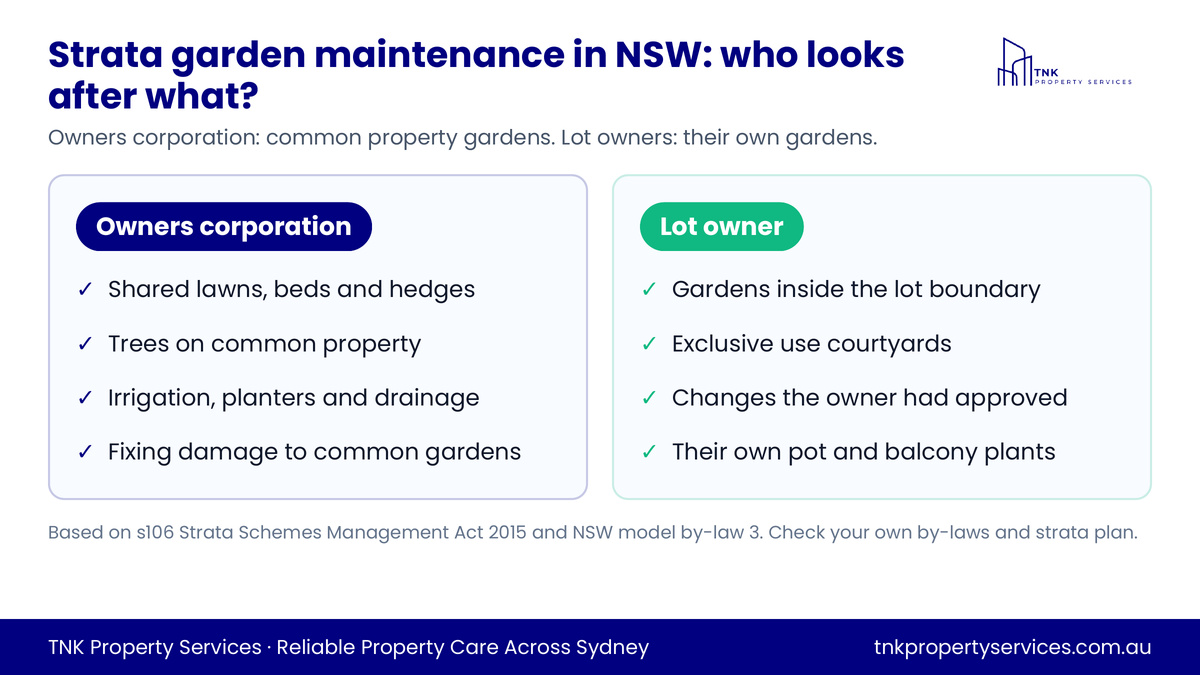
Under section 106 of the Strata Schemes Management Act 2015, the owners corporation must properly maintain and keep common property in a state of good and serviceable repair. In most schemes, shared gardens, lawns, trees and irrigation systems are common property, so strata garden maintenance sits with the owners corporation.
There are three common exceptions to check:
- Gardens that are part of a lot. Some townhouse and villa courtyards are inside the lot boundary on the strata plan. The lot owner maintains those.
- Exclusive use by-laws. An owners corporation can give one owner exclusive use of part of the common property, such as a courtyard garden, and make that owner responsible for its upkeep. The by-law should say who maintains what.
- Owner-made changes. If an owner got approval to change common property, for example new planter boxes, the special resolution under section 108 should say who maintains it. If it does not, the owners corporation keeps the ongoing maintenance.
Owners also have obligations. If your scheme uses the NSW model by-laws, model by-law 3 in Schedule 3 of the Strata Schemes Management Regulation 2016 says an owner or occupier must not damage any lawn, garden, tree, shrub, plant or flower on common property, or use common property as their own garden, without the owners corporation’s prior written approval. Check your registered by-laws, because many schemes have their own version.
Common grey areas
Disputes usually start with the same few items. Balcony planter boxes built into the building are often common property, but the plants inside may belong to the owner. Courtyard trees can sit on the lot while their roots lift common property paving. Irrigation lines may run through private courtyards to reach shared beds. When in doubt, ask your strata manager to check the strata plan and by-laws before work starts. Our guide to strata repairs in NSW explains how lot and common property boundaries usually work.
Who Pays for Strata Garden Maintenance, and Which Fund?
Routine strata garden maintenance is a recurring cost, so it is normally paid from the administrative fund and set in the annual budget. Bigger one-off projects that renew or replace common property are usually paid from the capital works fund, guided by the scheme’s 10-year capital works plan.
| Item | Usually paid from | Notes |
|---|---|---|
| Regular mowing, weeding, pruning and green waste | Administrative fund | Budget the full year, not just summer |
| Irrigation repairs and timer servicing | Administrative fund | Large system replacements may be capital works |
| Major landscaping upgrade or new garden design | Capital works fund | New structures may need a special resolution under section 108 |
| Tree removal or major tree work | Depends on scale | Get an arborist report and council approval first |
| Exclusive use courtyard | The owner with exclusive use | Only if the by-law makes them responsible |
| Damage caused by an owner or occupier | Owners corporation may recover from them | Keep photos, dates and contractor reports |
Trees on Common Property: Permits and Arborists
Trees are where strata gardening turns into risk management. A dropped limb can damage cars, roofs and people, and roots can crack pipes and paving. Build tree care into your plan rather than waiting for a storm.
- Check council rules first. Most Sydney councils require approval before you remove or significantly prune many trees on private land, including strata land. Each council sets its own tree controls, so check before booking work.
- Get owners corporation consent. Councils usually want proof that the owners corporation consents, such as meeting minutes or a letter from the strata manager.
- Use a qualified arborist. For large trees, structural concerns or work near powerlines, engage a qualified arborist. A routine gardener should not climb or fell trees.
- Know when you need a vote. Pruning or removing a dead or dangerous tree is usually maintenance. Removing a healthy tree to change the look of the grounds can be a change to common property and may need a special resolution.
9 Essential Checks Before You Sign a Strata Garden Maintenance Contract
Price matters, but the cheapest quote can cost more if it leaves out green waste, chemical training or reporting. Use these 9 essential checks to compare strata garden maintenance quotes on a like-for-like basis.
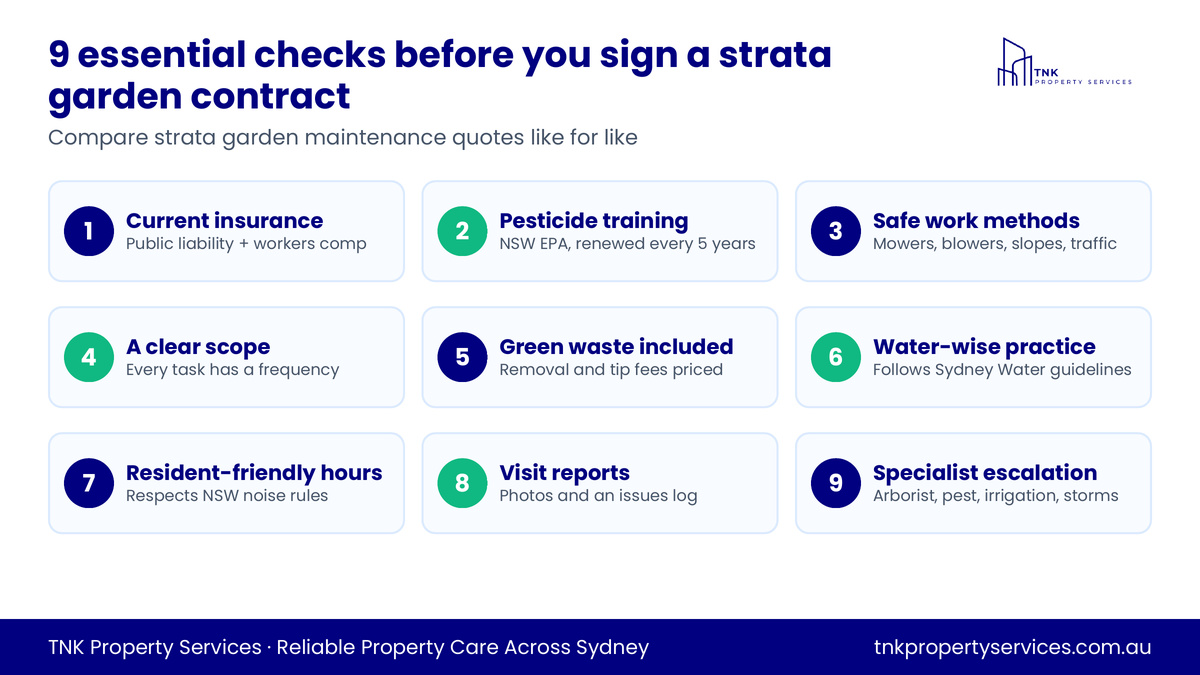
- Current insurance. Ask for certificates of currency for public liability and workers compensation. Check the names and expiry dates.
- Pesticide training. In NSW, people who use herbicides or other pesticides for work must be trained and keep that training current. The NSW EPA says training must be renewed every 5 years, and unsupervised operators should hold AQF level 3 training. Ask for proof.
- Safe work methods. Ask how they manage mowers, blowers, hedge trimmers, ladders, slopes and traffic near driveways. A short risk assessment for your site is a good sign.
- A clear scope. Every task should have a frequency. “General garden maintenance” is not a scope.
- Green waste included. Confirm whether clippings and prunings are removed, and whether tip fees are in the price.
- Water-wise practice. Sydney Water’s Water Wise Guidelines limit when and how you water with drinking water. Your contractor should follow them and set irrigation timers to match.
- Resident-friendly hours. NSW noise rules restrict when powered garden equipment can be used on residential premises. Agree visit times that respect residents and the current rules.
- Reporting. Ask for a short visit report with photos, plus a heads-up on issues such as dead trees, trip hazards, leaks or pests.
- Escalation for specialist work. Know who handles arborist work, pest control, irrigation installs and storm clean-ups, and how those are priced.
If you are running a formal tender, the same approach applies as for cleaning. Our strata cleaning tender guide includes a weighted scorecard you can adapt for gardening quotes.
Seasonal Strata Garden Plan for Sydney
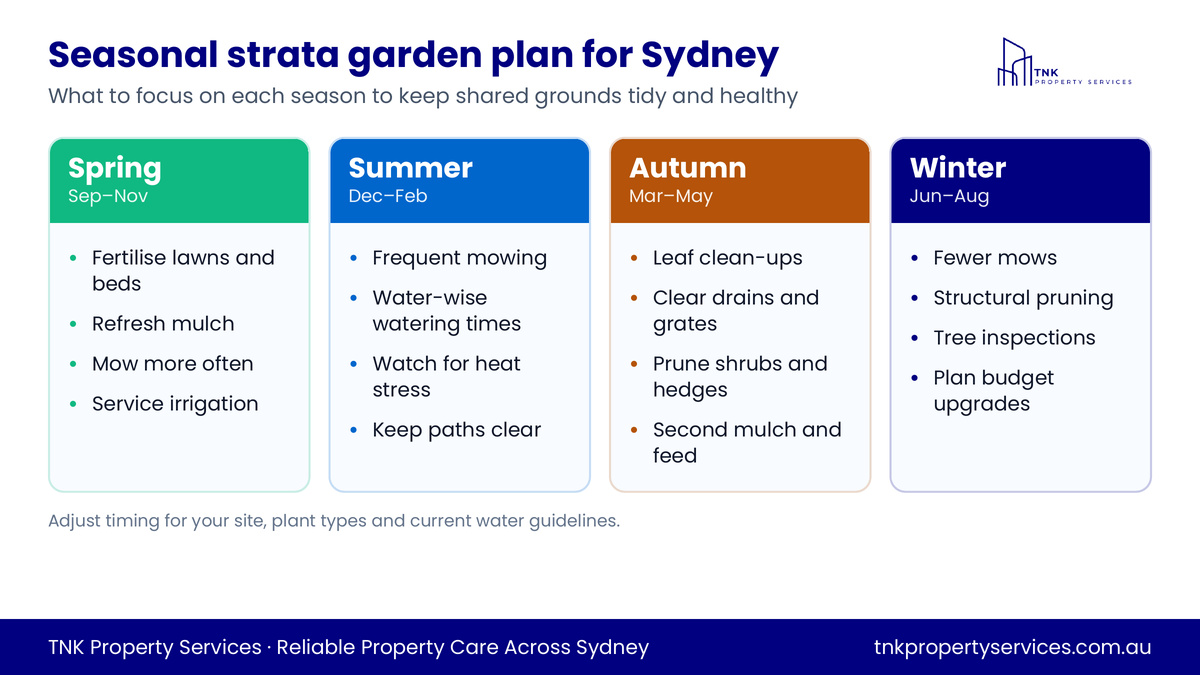
Sydney’s warm, humid summers and mild winters mean growth slows but never fully stops. A seasonal plan keeps visits efficient and avoids paying for the same clean-up twice.
| Season | Focus |
|---|---|
| Spring (Sep to Nov) | Fertilise lawns and beds, refresh mulch, start more frequent mowing, service irrigation before summer |
| Summer (Dec to Feb) | Mow often, check irrigation and watering times, watch for heat stress, keep paths clear of fast growth |
| Autumn (Mar to May) | Leaf clean-ups, clear drains and grates, prune many shrubs and hedges, second mulch and feed |
| Winter (Jun to Aug) | Fewer mows, structural pruning where suitable, tree inspections, plan any upgrades for the next budget |
Mulch is one of the cheapest upgrades. Sydney Water suggests a 7 to 10 cm layer of mulch to help reduce evaporation, which can also cut weeding time.
Strata Garden Maintenance Cost in Sydney
Strata garden maintenance pricing depends on the size and layout of the grounds, how often you want visits, the number of workers needed, access, and whether green waste is included. Most contractors quote a fixed price per visit or per month after a site inspection.
As an indicative guide only, hipages’ 2026 cost guide puts gardener rates for lawn mowing at about $45 to $85 an hour, with an average around $65, and more skilled garden work at about $80 to $120 an hour. Arborists start from around $70 to $100 or more an hour. These are national market figures, not TNK prices, and your quote may be higher or lower.
Ways to get better value:
- Ask for a fixed price per visit with a clear list of inclusions.
- Confirm whether prices include GST.
- Agree a seasonal frequency, for example weekly in summer and fortnightly in winter.
- Bundle garden, cleaning and minor maintenance with one provider to reduce call-out and admin time.
- Price one-off work such as tree work, planting and irrigation upgrades separately so they can be approved on their own.
For a sense of how the cost of shared services stacks up, see our strata cleaning cost guide.
How to Write a Strata Garden Maintenance Scope
A short, clear scope is the best protection against disputes. Here is a simple five-step process that works for most committees.
- Walk the site. Mark every garden area, lawn, tree, planter and irrigation zone on a site plan. Note which are lot property or exclusive use.
- List tasks and frequencies. Use the table above as a starting point. Add site-specific items such as pool surrounds or green walls.
- Set standards. Describe the result you expect, for example “paths clear of clippings and debris after every visit”.
- Agree reporting. Ask for visit notes with photos and a simple issues log.
- Review twice a year. Check the scope before summer and before the annual budget, so the administrative fund matches the work.
If your building has a building manager, they can supervise the contractor and check the reports. Read what a building manager does for more on that role.
How TNK Helps with Strata Garden Maintenance
Our garden maintenance service covers lawn mowing and edging, hedge trimming and pruning, garden bed weeding and mulching, tree care, seasonal planting and green waste removal. Our gardeners are police-checked and insured, and we start with a free on-site assessment and a no-obligation quote.
Many strata clients combine gardening with strata cleaning and maintenance or full building management, so there is one point of contact for the whole site.
Strata Garden Maintenance FAQs
Is the owners corporation responsible for strata garden maintenance?
Usually, yes. The owners corporation must maintain common property, which normally includes shared gardens, lawns and trees. Gardens that are part of a lot, or covered by an exclusive use by-law, are usually the owner’s responsibility.
Can I plant in the common property garden outside my unit?
Not without approval if your scheme uses model by-law 3. It says owners and occupiers must not use common property as their own garden without the owners corporation’s prior written approval. Ask your strata manager first.
Who pays for removing a tree in a strata garden?
If the tree is on common property, the owners corporation usually pays. Get an arborist’s advice and check whether your council needs to approve the work before booking it.
How often should strata gardens be maintained?
Many Sydney schemes book weekly or fortnightly visits in the warmer months and fortnightly or monthly visits in winter. Large or high-profile sites often need more frequent care.
Do strata gardeners need a licence to spray weeds?
In NSW, anyone using pesticides, including herbicides, as part of their work must complete approved training and renew it every 5 years. Ask your contractor for proof before they spray.
Get a Strata Garden Maintenance Quote
Want neat, safe grounds with a clear scope and regular reports? Tell us your building address, the garden areas you need covered and how often you would like visits. We will arrange a free on-site assessment and send a written quote, ready for your next committee meeting.
Request your free strata garden maintenance quote or call 02 8859 8976. We look after properties across Greater Sydney. Check our service areas to confirm your suburb.
This guide gives general information about strata garden maintenance in NSW, based on NSW legislation and NSW Government, NSW EPA and Sydney Water guidance as at November 2026. It is not legal advice. Your by-laws, strata plan and local council rules may change who is responsible and what approvals you need. Cost figures are indicative market data, not TNK prices. Last reviewed November 2026.