In this article
- What Strata Carpet Cleaning Covers
- Who Is Responsible for Strata Carpet Cleaning in NSW?
- Who Pays for Strata Carpet Cleaning, and Which Fund?
- How Often Should Strata Carpet Be Cleaned?
- Strata Carpet Cleaning Methods Compared
- Safety, Drying and Resident Disruption
- Strata Carpet Cleaning Cost in Sydney
- 8 Essential Checks Before You Hire a Strata Carpet Cleaning Contractor
- Clean or Replace? Planning for New Strata Carpet
- How TNK Can Help Your Strata Building
- Strata Carpet Cleaning FAQs
Quick answer: In NSW, strata carpet cleaning for common areas such as lobbies, corridors, stairs and lift landings is the owners corporation‘s job, because it must maintain common property. Carpet inside an apartment belongs to that lot, so the owner looks after it. Routine carpet cleaning is a recurrent cost paid from the administrative fund, while replacing worn common area carpet is usually a capital works fund expense. Most buildings need regular vacuuming plus a professional deep clean every 3 to 12 months, depending on foot traffic.
Carpet in a strata building takes a beating. Residents, removalists, couriers, wet umbrellas and the odd spilt coffee all end up in the same hallways. This guide explains who is responsible, which fund pays, how often to clean, which method suits which area, indicative Sydney costs, and 8 essential checks before you sign a carpet cleaning contract.
We are TNK Property Services. Our team brings more than 10 years of hands-on experience caring for Sydney properties, and we wrote this for strata managers, owners corporation committees, building managers and property managers who want common area carpets that look good, stay safe and last longer.
In this guide
- What strata carpet cleaning covers
- Who is responsible for strata carpet cleaning in NSW?
- Who pays, and which fund is used?
- How often should common area carpet be cleaned?
- Carpet cleaning methods compared
- Safety, drying and resident disruption
- Strata carpet cleaning cost in Sydney
- 8 essential checks before you hire
- Clean or replace? Planning for new carpet
- How TNK can help your strata building
- Strata carpet cleaning FAQs
What Strata Carpet Cleaning Covers
Strata carpet cleaning is the routine and periodic care of carpet on common property. On a typical Sydney apartment block, that is the ground floor lobby, lift lobbies on each level, corridors, carpeted stairs and landings, the inside of lifts, entrance mats and any shared rooms such as a meeting room, gym or residents’ lounge.
A good program mixes three types of work. Daily or weekly vacuuming removes loose grit. Spot cleaning deals with spills before they set. Periodic deep cleaning removes the oily, sticky soil that vacuuming cannot lift. The table shows typical areas and what each one usually needs.
| Area | Why it gets dirty | What it usually needs |
|---|---|---|
| Ground floor lobby and entry mats | Grit, water and leaves from outside | Vacuum every clean, mats vacuumed and washed, frequent spot cleaning |
| Lift lobbies | Every resident walks through them | Vacuum every clean, traffic lanes deep cleaned more often |
| Corridors | Shoes, food deliveries, bins wheeled to chutes | Regular vacuuming, periodic deep clean, edge and skirting detail |
| Carpeted stairs and landings | Concentrated wear on nosings and corners | Hand tools for edges, careful drying so stairs are not slippery |
| Lift car carpet | Very heavy traffic in a small space | Frequent vacuuming and spot cleaning, often low-moisture methods |
| Shared rooms (gym, lounge, meeting room) | Lighter but irregular use, spills at events | Vacuum on schedule, deep clean once or twice a year |
Carpet care sits inside your wider strata cleaning program. If you are reviewing the whole scope, our strata cleaning checklist shows how we split tasks and frequencies across lobbies, corridors, car parks and bin rooms. Many buildings also include window cleaning for foyer glass and common windows in the same scope. In mixed-use buildings, common area work often sits alongside a commercial cleaning or office cleaning program for the tenancies.
Who Is Responsible for Strata Carpet Cleaning in NSW?
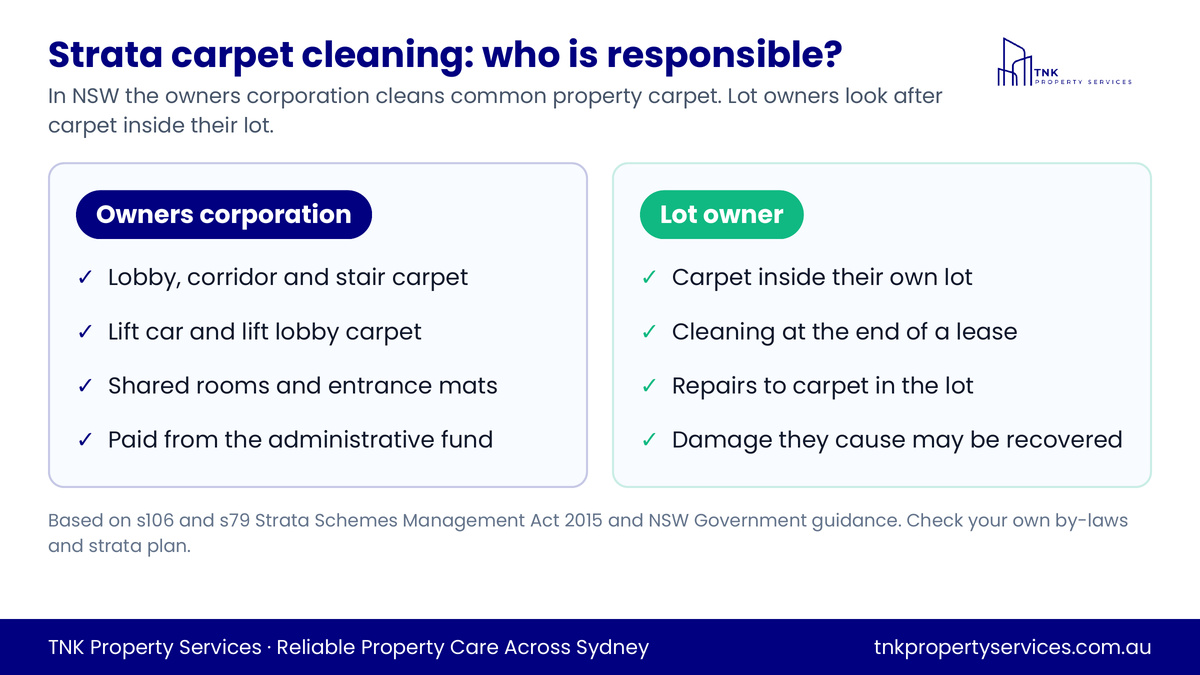
Under section 106 of the Strata Schemes Management Act 2015, the owners corporation must properly maintain and keep common property in a state of good and serviceable repair. The NSW Government’s strata repairs and maintenance guide lists “carpets on common property (such as hallways)” as an owners corporation responsibility, and “carpet in your property” as the owner’s responsibility.
In practice, that means:
- Owners corporation: lobby, corridor, stair, lift and shared room carpet, plus entrance mats it owns.
- Lot owner: carpet inside their apartment or townhouse, including cleaning at the end of a lease.
- Tenant: day-to-day care of carpet inside the rented lot, as set out in their lease. Tenants should raise common area issues with their landlord or agent, not the committee directly.
Common grey areas
Most disputes come from damage rather than routine cleaning. If a removalist tears corridor carpet, or a leak from inside an apartment soaks the hallway, the owners corporation may look at recovering the cost from whoever caused it. Check your by-laws too. Many schemes have by-laws about moving furniture through common property and about floor coverings inside lots to limit noise. If you are unsure where the lot boundary sits, ask your strata manager to check the strata plan. Our guide to strata repairs in NSW explains how lot and common property boundaries usually work. Day-to-day strata maintenance, such as handyman repairs, pressure washing and gutter cleaning, is often planned alongside carpet care.
Who Pays for Strata Carpet Cleaning, and Which Fund?
Section 79 of the Strata Schemes Management Act 2015 makes this unusually clear. Its note on the administrative fund lists “carpet cleaning” as an example of a recurrent expense, alongside insurance, water, electricity and lawn mowing. So regular strata carpet cleaning belongs in the administrative fund budget set at each AGM.
Replacing carpet is different. Renewing or replacing fixtures and fittings that are part of common property is a capital works fund expense, guided by the scheme’s 10-year capital works fund plan.
| Item | Usually paid from | Notes |
|---|---|---|
| Routine vacuuming and spot cleaning | Administrative fund | Normally part of the regular cleaning contract |
| Periodic deep cleaning of common area carpet | Administrative fund | Budget for the full year, not just one clean |
| Entrance mat hire or replacement | Administrative fund | Larger matting upgrades may be capital works |
| Replacing worn corridor or lobby carpet | Capital works fund | Should appear in the 10-year plan |
| Carpet damaged by an owner, tenant or their contractor | Owners corporation first | It may seek to recover the cost under the Act or by-laws |
| Carpet inside a lot | Lot owner | Not an owners corporation expense |
For a wider view of cleaning budgets, see our guide to strata cleaning cost in Sydney.
How Often Should Strata Carpet Be Cleaned?
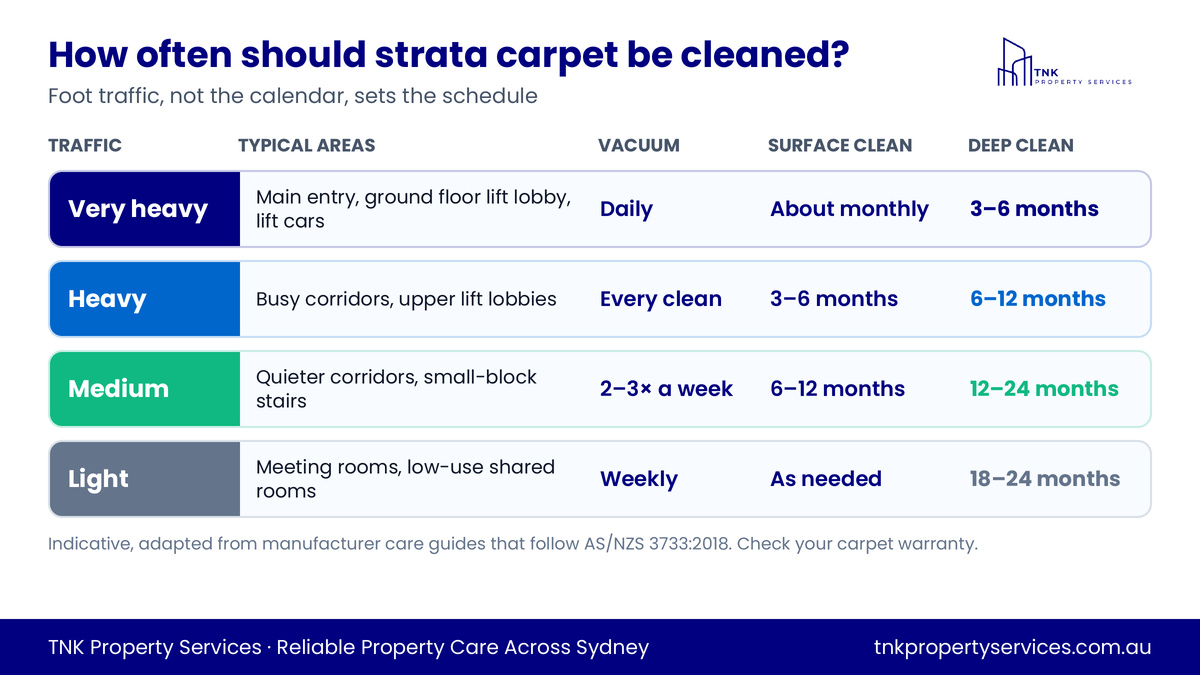
The Australian Standard AS/NZS 3733:2018 covers cleaning maintenance of residential and commercial carpet, and most manufacturers base their care instructions on it. The key idea is simple: foot traffic, not the calendar, sets the frequency. Flooring manufacturers’ care guides that follow AS/NZS 3733 group corridors and foyers as heavy or very heavy traffic areas.
Use the table below as a starting point for strata carpet cleaning, then adjust for your building’s size, carpet colour and how residents use the space.
| Traffic level | Typical strata areas | Vacuuming | Surface (interim) clean | Deep (restorative) clean |
|---|---|---|---|---|
| Very heavy | Main entry, lift lobby on the ground floor, lift cars | Daily | About monthly | Every 3 to 6 months |
| Heavy | Busy corridors, lift lobbies on upper floors | Daily or every clean | Every 3 to 6 months | Every 6 to 12 months |
| Medium | Quieter corridors, stairs in small blocks | 2 to 3 times a week | Every 6 to 12 months | Every 12 to 24 months |
| Light | Meeting rooms, low-use shared rooms | Weekly | As needed | Every 18 to 24 months |
Frequencies are indicative and adapted from manufacturer care guides that follow AS/NZS 3733:2018. Always check your carpet manufacturer’s warranty conditions.
Two quick wins help any schedule. First, good entrance matting catches a large share of soil before it reaches the carpet, so keep mats clean and replace them when worn. Second, keep a simple log of each deep clean. Some carpet warranties ask for proof of regular professional cleaning if you ever make a claim.
Strata Carpet Cleaning Methods Compared
There is no single best method for strata carpet cleaning. The right choice depends on the fibre, how dirty the carpet is and how quickly the area must be back in use. Many buildings use a low-moisture method for regular refreshes and hot water extraction for periodic deep cleans.
| Method | How it works | Best for | Typical drying time |
|---|---|---|---|
| Hot water extraction (often called steam cleaning) | Cleaning solution is injected and extracted with a powerful vacuum | Periodic deep or restorative cleans | Several hours, longer in cool or humid weather |
| Encapsulation | A low-moisture solution wraps soil into crystals that are vacuumed away | Regular interim cleans in busy corridors | Often about an hour |
| Bonnet or pad cleaning | A rotary machine with an absorbent pad lifts surface soil | Quick appearance refresh of traffic lanes | Often under an hour |
| Dry compound | An absorbent powder is brushed in, then vacuumed out | Areas that must stay in use, lift cars | Very short |
Ask your contractor to identify the carpet fibre before they recommend a method. Wool, nylon and polypropylene respond differently to heat and chemicals. Using the wrong product can leave residue that attracts dirt faster, or cause shrinkage and colour loss.
Safety, Drying and Resident Disruption
Corridors and stairs are escape routes as well as walkways, so the way strata carpet cleaning is done matters as much as the result. SafeWork NSW’s guidance on slips, trips and falls lists slippery floors from cleaning products, changes from one floor surface to another, and loose cords as common risks. Its prevention guide recommends cleaning when foot traffic is low and keeping people off areas until they are fully dry.
For strata buildings, that usually means:
- Scheduling deep cleans after hours or on weekends, one floor or wing at a time.
- Giving residents written notice in lifts and on the noticeboard a few days ahead.
- Using wet floor signs and barriers, and keeping stairs and exit paths clear.
- Running hoses and leads so they do not create trip hazards across corridors.
- Having Safety Data Sheets on hand for every chemical, and choosing eco-friendly, low-odour products where they suit the job.
- Running air conditioning or fans to speed drying where the building allows it.
Strata Carpet Cleaning Cost in Sydney
Published Sydney price guides from commercial cleaning companies in 2026 put commercial carpet cleaning at roughly $3 to $8 per square metre, with strata common areas often at the upper end. These are indicative market figures only, not TNK prices. Your quote will depend on your building.
| Cost driver | Why it changes the price |
|---|---|
| Carpet area (m²) | Larger areas spread set-up and travel costs, so the rate per m² often falls |
| Method | Hot water extraction usually costs more per m² than low-moisture methods |
| Layout | Many small lift lobbies and stairs take longer than one long corridor |
| Condition | Heavy soiling, old stains and odours need extra treatment |
| Timing | After-hours or weekend work may be priced differently |
| Access | Parking, water and power access, and lift bookings affect time on site |
| Frequency | A scheduled program is usually better value than one-off call-outs |
When you compare strata carpet cleaning quotes, check whether each one includes GST, how many square metres it covers, and how many deep cleans per year are included. If you are going to market, our strata cleaning tender pack helps you compare contractors like for like.
8 Essential Checks Before You Hire a Strata Carpet Cleaning Contractor
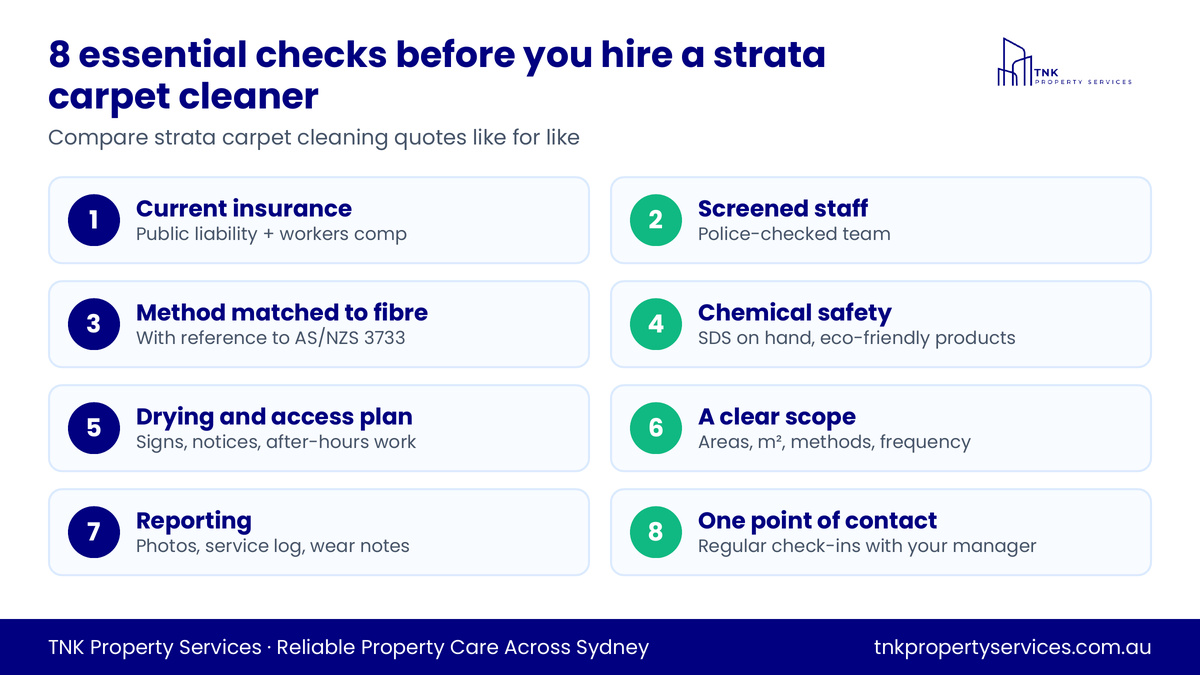
- Current insurance. Ask for certificates of currency for public liability and workers compensation.
- Screened staff. Residents will see the team in corridors and lifts, so ask whether staff are police-checked.
- A method matched to the carpet. The contractor should identify the fibre and explain their approach with reference to AS/NZS 3733.
- Chemical safety. Ask for Safety Data Sheets and whether they use eco-friendly, low-residue products.
- A drying and access plan. Signage, barriers, resident notices and after-hours or weekend work where needed.
- A clear scope. Areas, square metres, methods and frequencies written down, plus what is excluded.
- Reporting. Before and after photos, a service log and notes on wear, damage or stains that will not shift.
- One point of contact. For strata carpet cleaning across a busy building, you want someone who answers the strata manager quickly and checks in regularly.
Clean or Replace? Planning for New Strata Carpet
Even the best strata carpet cleaning cannot fix worn pile, fraying edges, ripples or permanent stains. If corridors still look tired straight after a deep clean, or there are trip hazards from lifting seams, it is time to look at your 10-year capital works fund plan.
- Quotes: the NSW Government notes that all schemes must get at least two independent quotes for any work valued at $30,000 or more.
- Fire safety: replacement carpet in common corridors of apartment buildings generally has to meet the fire hazard properties set by the National Construction Code, so ask the supplier for test reports.
- Noise and by-laws: check any by-laws and approvals that affect floor coverings before the committee chooses a product.
- Maintenance plan: agree the cleaning program for the new carpet on day one, so it lasts the full life in your plan.
How TNK Can Help Your Strata Building
We look after common areas for strata buildings across Sydney, with a focus on Western Sydney, Parramatta and the Hills District. Our team has more than 10 years of hands-on experience. Staff are police-checked, we hold public liability and workers compensation insurance, we use licensed trades and eco-friendly products, and we can work after hours and on weekends to keep disruption low. Every site has a dedicated account manager, checklists, photo reports and regular check-ins with the strata manager.
Carpet care is usually one part of a broader building program. These are the TNK services most relevant to strata and mixed-use buildings:
- Building and facility management, including on-site managers, contractor coordination and maintenance registers.
- Strata cleaning of common areas, including lobbies, corridors, car parks and bin rooms.
- Strata maintenance, including handyman work, pressure washing, window and gutter cleaning.
- Garden maintenance for common gardens, lawns and grounds.
- Commercial cleaning for commercial and mixed-use properties.
- Office cleaning for commercial tenancies in mixed-use buildings.
- Carpet cleaning for common area lobbies, corridors, stairs, lift cars and shared rooms, as a scheduled program or as periodic deep cleans.
- Window cleaning for foyers, common glass and building exteriors.
- End of lease cleaning for lot owners, agents and tenants who need the carpet and interior of a lot cleaned at handover.
Want a clear carpet plan for your building? Book a free site inspection and we will walk your common areas, measure the carpet and recommend a schedule that suits your traffic and budget. You can also call us on 02 8859 8976.
Strata Carpet Cleaning FAQs
Who pays for strata carpet cleaning in NSW?
The owners corporation pays for cleaning carpet on common property, such as lobbies, corridors and stairs. It is a recurrent cost from the administrative fund. Owners pay for carpet inside their own lot.
How often should strata carpet cleaning be done?
Vacuum busy areas at every clean and arrange a professional deep clean every 3 to 12 months, depending on foot traffic. Main entries and lift lobbies need the most attention. Quieter areas can go longer between deep cleans.
Is carpet replacement paid from the capital works fund?
Usually, yes. Renewing or replacing fixtures and fittings that are part of common property is a capital expense, so it should be planned in the 10-year capital works fund plan.
How long does common area carpet take to dry?
Low-moisture methods are often dry in about an hour. Hot water extraction can take several hours, and longer in cool or humid weather. Good airflow helps, and areas should stay signed until fully dry.
Can carpet cleaning be done after hours?
Yes. Strata carpet cleaning is often booked after hours. Many buildings schedule deep cleans in the evening or on weekends, one floor at a time, so residents can still get in and out safely.
Do tenants or owners pay to clean corridor carpet they damage?
The owners corporation usually arranges the repair or cleaning first. Depending on the circumstances and your by-laws, it may then seek to recover the cost from the person responsible.
This guide is general information, not legal advice. Check your own strata plan, by-laws and current NSW requirements, and speak to your strata manager for advice on your scheme.