In this article
- Who Is Responsible for Strata Window Cleaning in NSW?
- Who Pays for Strata Window Cleaning, and Which Fund Is Used?
- Strata Window Cleaning Access Methods
- 7 Essential Safety Checks Before Strata Window Cleaning Starts
- Window Safety Devices: The Other Window Rule
- How Often Should Strata Windows Be Cleaned?
- Strata Window Cleaning Cost in Sydney
- How to Set Up a Strata Window Cleaning Program
- Why Sydney Buildings Choose TNK for Window Cleaning
- Strata Window Cleaning FAQs
- Get a Strata Window Cleaning Quote
Quick answer: In NSW, strata window cleaning is shared. Under the model by-laws, lot owners clean the inside and outside of the glass on their own lot, but the owners corporation must regularly clean any exterior glass that owners cannot reach safely or at all. That usually means high external windows, façade glass and common area glass. The work must be done safely, which in practice means a qualified contractor, inspected anchor points and the right access method for the height.
Getting strata window cleaning right is part legal question, part safety question. This guide covers who is responsible, who pays, access methods, safety checks, frequency and cost in plain English.
We are TNK Property Services, a Smithfield-based family business that has looked after Sydney properties for more than a decade. We wrote this for strata managers, owners corporation committees, building managers and owners who want a clear, safe plan for their building’s glass.
In this guide
- Who is responsible for strata window cleaning in NSW?
- Who pays, and which fund is used?
- Strata window cleaning access methods
- 7 essential safety checks before work starts
- Window safety devices: the other window rule
- How often should strata windows be cleaned?
- Strata window cleaning cost in Sydney
- How to set up a strata window cleaning program
- Strata window cleaning FAQs
Who Is Responsible for Strata Window Cleaning in NSW?
The starting point is model by-law 13 in Schedule 3 of the Strata Schemes Management Regulation 2016. It says two things:
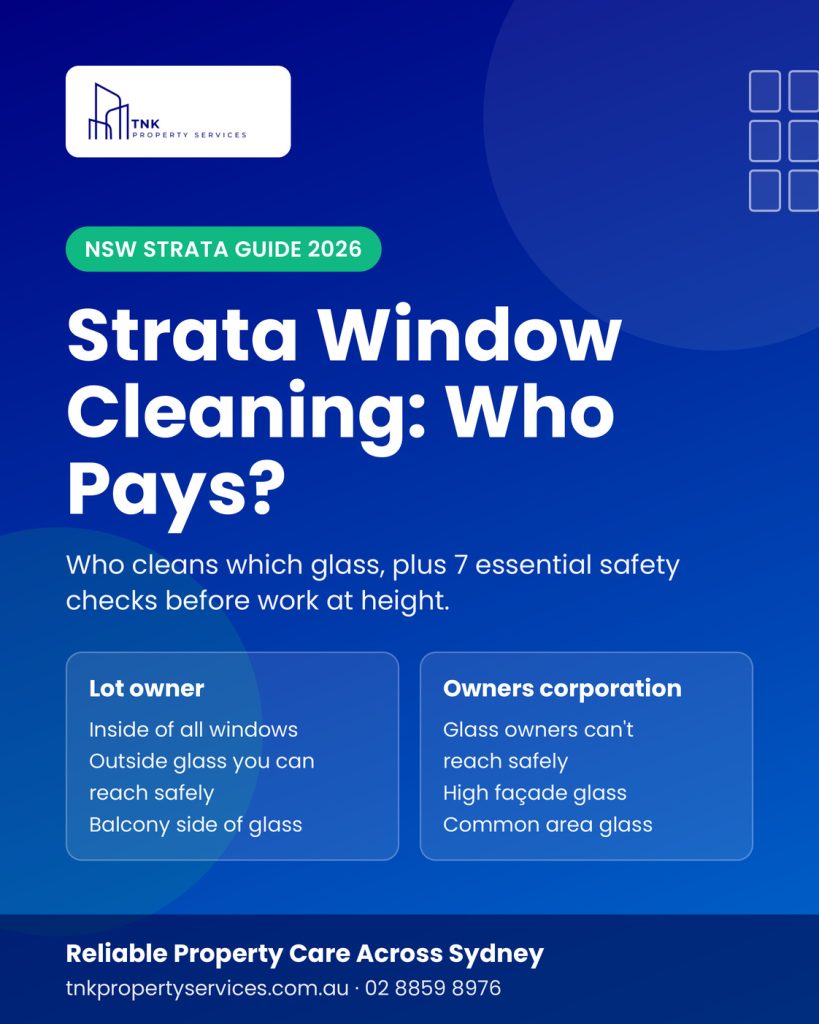
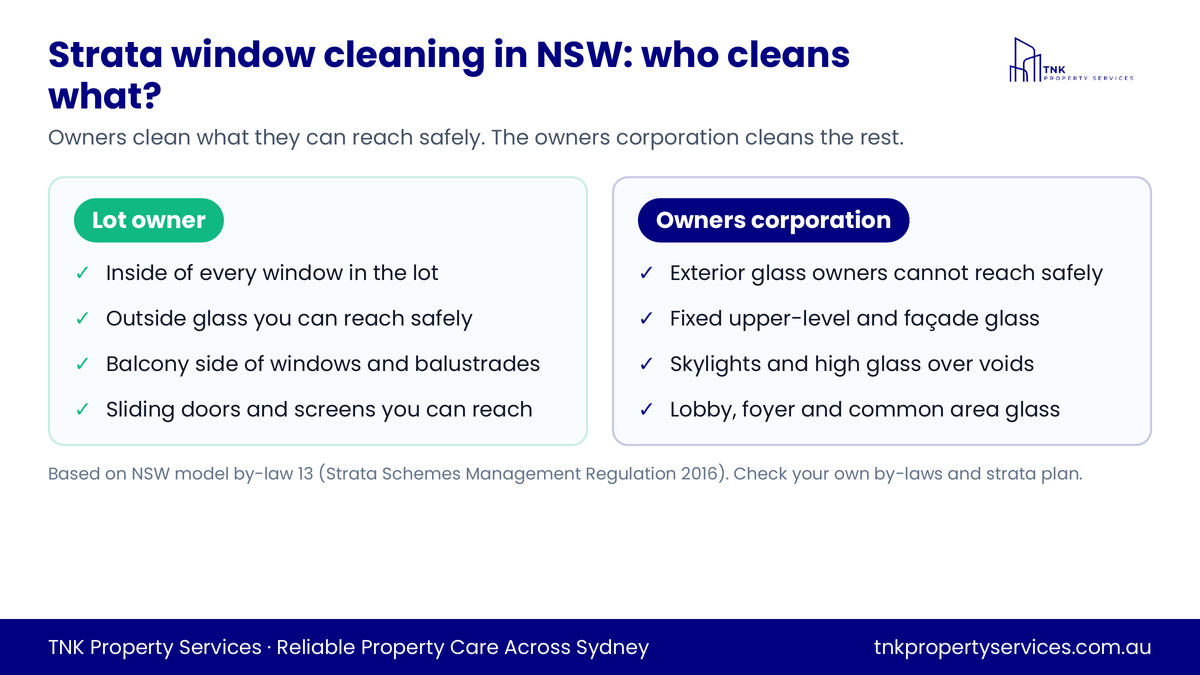
- An owner or occupier is responsible for cleaning all interior and exterior surfaces of glass in windows and doors on the boundary of their lot, including glass that is common property.
- The owners corporation is responsible for regularly cleaning all exterior surfaces of glass in windows and doors that cannot be accessed by the owner or occupier safely or at all.
The NSW Government’s strata repairs and maintenance guidance puts it simply: window cleaning is usually the owner’s job, “unless you can’t access it (for example, if it is too high)”.
One important catch: model by-laws only apply if your scheme adopted them or they were lodged with the strata plan. Many buildings have their own window cleaning by-law, so check your registered by-laws first. Your strata manager can give you a copy.
What “cannot be accessed safely” looks like in practice
The by-law does not list heights or window types, so committees have to apply common sense. These are typical examples of glass an owner usually cannot clean safely:
- The outside of fixed windows above ground level, with no balcony in front
- Glass that can only be reached by leaning out of a window or over a balustrade
- Façade and curtain wall glass on a mid-rise or high-rise building
- Skylights and high glass over voids, atriums or stairwells
- The outer face of glass balustrades on upper floors
Glass an owner can usually reach safely includes the inside of every window, sliding doors, and the balcony side of windows and balustrades they can stand next to. Common property glass inside the building, such as lobby doors and lift lobby glass, is normally part of your regular strata cleaning scope.
Grey areas to settle in writing
Disputes tend to come from awkward windows: a ground-floor courtyard window over a garden bed, a louvre window above a stair, or a top-floor window that opens inward. If the answer is unclear, ask the committee to record a decision in the minutes. Some owners corporations simply resolve to clean all exterior glass on a schedule, which ends the argument.
Who Pays for Strata Window Cleaning, and Which Fund Is Used?
When the owners corporation is responsible, strata window cleaning is paid for through strata levies. Because it is a regular, recurring cost, it normally sits in the administrative fund budget alongside common area cleaning and gardening.
Bigger height safety items are different. Installing a new roof anchor system, replacing failed anchors or adding a davit arm or building maintenance unit is often planned through the capital works fund and the building’s 10-year capital works plan.
| Item | Usually responsible | Usually paid from |
|---|---|---|
| Inside of all windows in a lot | Lot owner or occupier | Owner (not strata levies) |
| Outside glass the owner can reach safely | Lot owner or occupier | Owner |
| Outside glass that cannot be reached safely | Owners corporation | Administrative fund |
| Lobby, foyer and common area glass | Owners corporation | Administrative fund (regular cleaning) |
| Annual anchor point inspection | Owners corporation | Administrative fund |
| New or replacement height safety system | Owners corporation | Capital works fund, as planned |
This table assumes model by-law 13 applies. Your own by-laws and strata plan can change the answer.
Strata Window Cleaning Access Methods
The access method drives both safety and cost. Under NSW work health and safety rules, a business managing fall risks must work through a hierarchy of controls. SafeWork NSW’s working at heights guidance sets out the order: work from the ground or a solid construction where possible, then use fall prevention devices, then work positioning systems such as industrial rope access, and only then fall arrest systems.
For strata window cleaning, that usually translates into four methods.
| Method | Typical use | Things to know |
|---|---|---|
| Water-fed pole from the ground | Low-rise buildings, ground and lower levels | No one works at height. Purified water dries without streaks. Reach is limited by height and site layout. |
| Elevating work platform (EWP) | Low and mid-rise glass with good ground access | Needs firm, level ground and space. Operating a boom-type EWP with a boom of 11 metres or more needs a high risk work licence. |
| Industrial rope access (abseiling) | Mid-rise and high-rise façades | Needs at least two independent, inspected anchors per drop and trained technicians. Little ground space needed. |
| Building maintenance unit or swing stage | Towers designed with a permanent system | The plant itself must be maintained and inspected. Usually specified when the building was designed. |
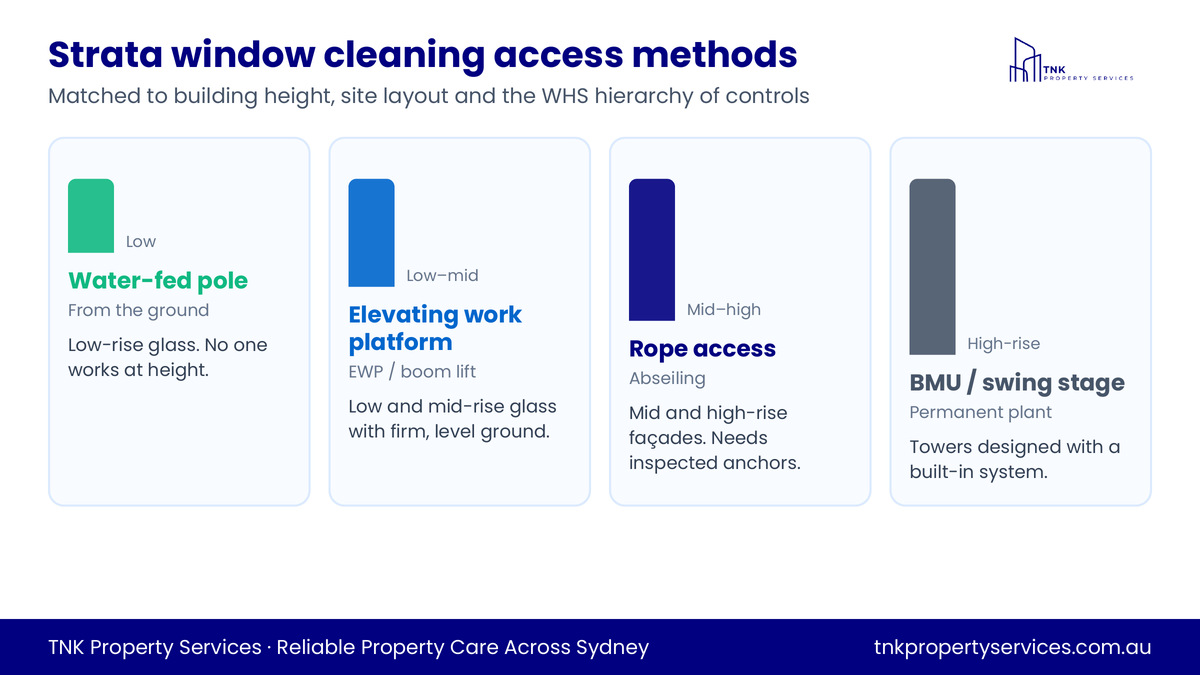
Many buildings use more than one method. A common mix is a water-fed pole for the lower levels and rope access for the upper façade. TNK’s window cleaning services use rope access, water-fed poles and abseiling techniques with purified water systems, and we confirm the right method for your building at a free on-site assessment.
7 Essential Safety Checks Before Strata Window Cleaning Starts
Falls from height are among the most serious risks in building maintenance. The contractor carries the main work health and safety duties for its workers, but the committee or building manager can make sure the job is set up properly. Run through these seven checks before work begins.
- Anchor points are in date. Ask for the building’s anchor inspection register. SafeWork NSW advice is that inspection programs based on AS/NZS 1891.4, including annual load testing of chemical and friction anchors, should continue for all installed anchors. Safe Work Australia’s rope access guide says anchors should be load tested before first use and then at least annually. An anchor with an expired tag should not be used.
- A written safe work method statement or risk assessment. It should be specific to your building and explain the access method, drops, exclusion zones and rescue plan.
- Proof of training. Rope access technicians should hold recognised rope access certification, and EWP operators should hold the right licence for the machine being used.
- Current insurance. Ask for certificates of currency for public liability and workers compensation, and check the dates cover the job.
- A rescue plan. Anyone working on ropes or in a harness needs a tested way to be rescued quickly. “Call 000” is not a rescue plan.
- Public protection. Barricades and signs below each drop, a plan for entries, driveways and pool areas, and a stop-work rule for high winds or storms.
- Resident notice. Tell residents the dates and which side of the building is being cleaned, so they can close windows, move balcony items and draw blinds for privacy.
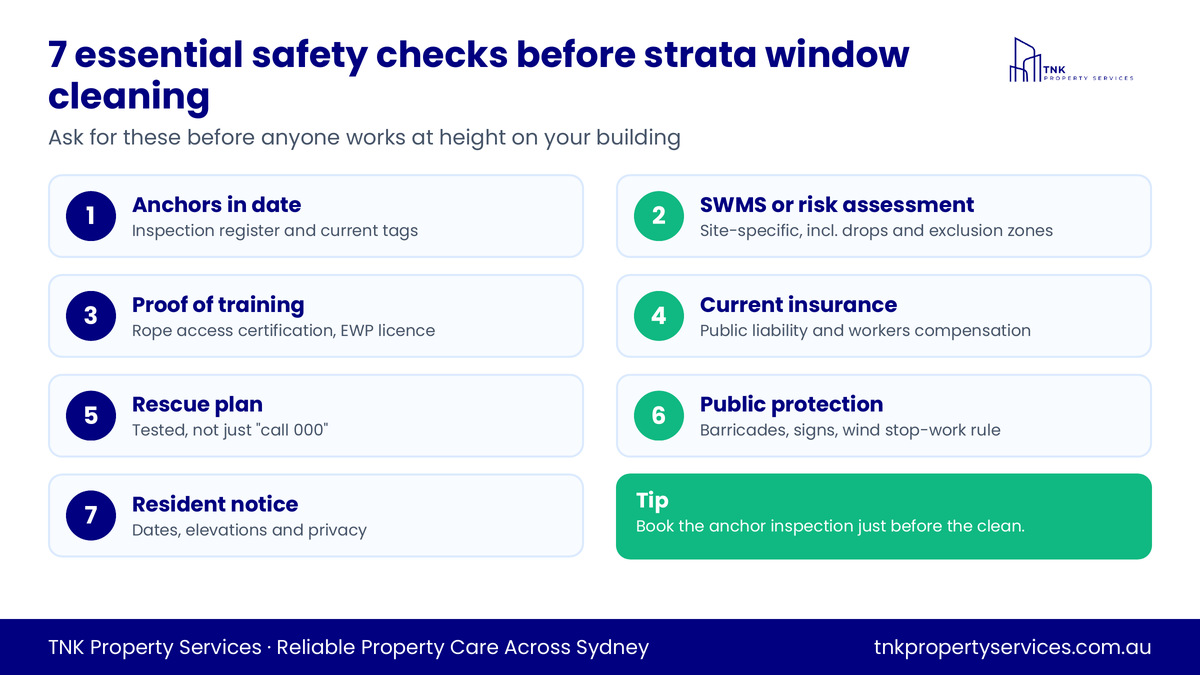
If you are comparing contractors, our strata cleaning tender pack lists the insurance and safety documents to request, and the same checks work for strata window cleaning contractors.
What if the building has no anchors?
Some older walk-up buildings have no roof anchors at all. That does not stop cleaning, but it changes the method. Lower levels can often be reached from the ground with water-fed poles, and an EWP may suit the rest. If rope access is the only realistic option, the owners corporation may need a height safety engineer or specialist installer to design and certify an anchor system first. Plan that through the capital works fund, because the same anchors also support painting, gutter and façade repairs.
Window Safety Devices: The Other Window Rule
Window cleaning and window safety are separate obligations, but they often come up together. Under section 118 of the Strata Schemes Management Act 2015 and clause 30 of the Regulation, residential strata buildings must have complying window safety devices on certain openable windows. The NSW Government’s strata safety rules summarise it:
- The rule applies where the lowest part of the window opening is less than 1.7 metres above the inside floor, and that floor is 2 metres or more above the ground outside.
- The device must stop the window opening more than 12.5 centimetres and resist an outward force of 250 newtons.
- Devices that can be removed or unlocked must have a child-resistant release.
- The owners corporation pays to install and repair them, unless the by-laws say otherwise.
Here is the practical link. If owners cannot open their windows far enough to clean the outside safely, more glass falls into the “cannot be accessed safely” category. That is another reason many committees choose a scheduled strata window cleaning program for all exterior glass.
How Often Should Strata Windows Be Cleaned?
There is no legal frequency. The by-law only says “regularly”. Most buildings set a schedule based on location, budget and how the building looks. These are typical starting points, not rules:
| Glass | Typical frequency | Clean more often if |
|---|---|---|
| Entry doors and lobby glass | Each cleaning visit | High foot traffic, kids, pets |
| Common area internal glass | Weekly to monthly | Gyms, pools and lift lobbies |
| Inaccessible exterior glass | Every 3 to 6 months | Coastal salt spray, main roads, nearby construction |
| Skylights and high internal glass | Every 6 to 12 months | Trees overhead, bird activity |
| Anchor point inspection | At least every 12 months | Harsh coastal or industrial environment |
Two tips save money. First, book the exterior clean straight after the anchor inspection so the contractor is not held up by expired tags. Second, avoid cleaning just before major façade work, painting or nearby demolition, which will undo the job.
Strata Window Cleaning Cost in Sydney
Strata window cleaning prices vary widely, so treat any figure as a budgeting guide only. As an indication, one Sydney rope access company’s 2026 price guide quotes roughly $800 to $2,500 for a maintenance clean of a 3 to 8 storey strata building, and $1,200 to $5,000 or more for 9 to 20 storeys, plus GST. These are indicative market figures, not TNK prices. Your building’s quote depends on a site assessment.
The main cost drivers are:
- Height and access method. Rope access and EWPs cost more than ground-level poles.
- Number of drops and faces. Each rope drop needs set-up time, and complex shapes take longer.
- Anchor condition. Expired or missing anchors add inspection or installation costs before cleaning can start.
- Glass condition. Hard water stains, paint overspray or construction residue need extra treatment.
- Frequency. A regular schedule usually costs less per visit than an occasional deep clean.
- Bundling. Combining strata window cleaning with gutter checks, façade inspections or pressure washing can reduce set-up costs.
For the bigger picture on budgeting regular common area cleaning, see our strata cleaning cost guide for Sydney. To check what your current contract includes, compare it with our free strata cleaning checklist.
Remember the quotes rule too. NSW guidance says all schemes must get at least two independent quotes for work valued at $30,000 or more, except emergency repairs. Larger towers on an annual window contract can reach that figure.
How to Set Up a Strata Window Cleaning Program
A simple program stops strata window cleaning from becoming a yearly argument. Here is a five-step approach that works for most buildings.
- Confirm responsibility. Check your by-laws and strata plan, then record in the minutes which glass the owners corporation cleans.
- Audit access. List each elevation, the glass on it and how it can be reached. Locate the anchor register and note the next inspection date.
- Get a scope and quotes. Give contractors the same written scope, frequency and access information so the quotes are comparable.
- Schedule and notify. Put the cleans and anchor inspections in the building calendar and send resident notices well ahead.
- Inspect and record. Ask for before and after photos and a short report of any defects spotted on the façade, such as cracked glass, failed seals or loose flashings.
That last step matters. A technician on the façade sees things no one else can. Defects found during strata window cleaning can be passed to your strata manager and fixed before they turn into leaks. Our guide to strata repairs in NSW explains who pays for those repairs and how to get them approved.
In larger buildings, a building manager can coordinate all of this. Read about our building management service, or see how window cleaning fits into our wider strata cleaning and maintenance service.
Why Sydney Buildings Choose TNK for Window Cleaning
TNK cleans windows from ground-level shops to high-rise towers. Our team uses rope access, water-fed poles and abseiling techniques with eco-friendly purified water systems, and we clean interior and exterior glass, skylights, façades, frames and sills.
- Free on-site assessment. We inspect your property and access requirements, then send a detailed, transparent quote.
- Quality you can check. Our quality management system is certified to ISO 9001:2015.
- Paperwork ready. We hold public liability and workers compensation insurance, and certificates of currency and safe work method statements are available on request.
- One local team. Cleaning, maintenance, gardens and building management from one Smithfield-based team, with one point of contact.
Strata Window Cleaning FAQs
Is the owners corporation responsible for cleaning my windows?
Only for exterior glass you cannot reach safely or at all, if your scheme uses model by-law 13. You clean the inside of your windows and any outside glass you can safely reach. Check your own by-laws, as they may say something different.
Can I hire my own window cleaner to abseil down to my unit?
Not without permission. Rope access uses the roof and anchors, which are common property. Ask the strata manager or committee first. It is usually easier and cheaper to wait for the building’s scheduled clean.
How do I know if our roof anchors are compliant?
Each anchor should have a current inspection tag and an entry in the building’s anchor register. If no one can find the register or the tags have expired, book an inspection by a competent height safety provider before any rope access work.
Do window cleaners need a licence in NSW?
There is no specific window cleaning licence, but some equipment needs one. For example, operating a boom-type EWP with a boom of 11 metres or more requires a high risk work licence. Rope access technicians should hold recognised rope access training.
Who cleans balcony balustrade glass?
Usually the owner cleans the side they can reach from the balcony. The outer face on upper floors often cannot be reached safely, so it may fall to the owners corporation under model by-law 13.
Get a Strata Window Cleaning Quote
Want clean glass without the safety headaches? Tell us your building address, number of levels and what glass you need covered. We will arrange a free on-site assessment and send a written scope and quote, ready for your next committee meeting.
Request your free strata window cleaning quote or call 02 8859 8976. We service buildings across Greater Sydney. Check our service areas to confirm your suburb.
This guide gives general information about strata window cleaning in NSW, based on NSW legislation, NSW Government and SafeWork NSW guidance as at November 2026. It is not legal or safety advice. Your by-laws and strata plan may change who is responsible, and contractors must assess the risks for each site. Last reviewed November 2026.