In this article
- What Strata Pressure Cleaning Covers
- Who Pays for Strata Pressure Cleaning in NSW?
- How Often Should You Book Strata Pressure Cleaning?
- Strata Pressure Cleaning Rules: Water and Stormwater in Sydney
- Safety Risks Committees Should Know
- 8 Essential Checks Before You Book Strata Pressure Cleaning
- What to Put in the Scope of Works
- How TNK Can Help
- Strata Pressure Cleaning FAQs
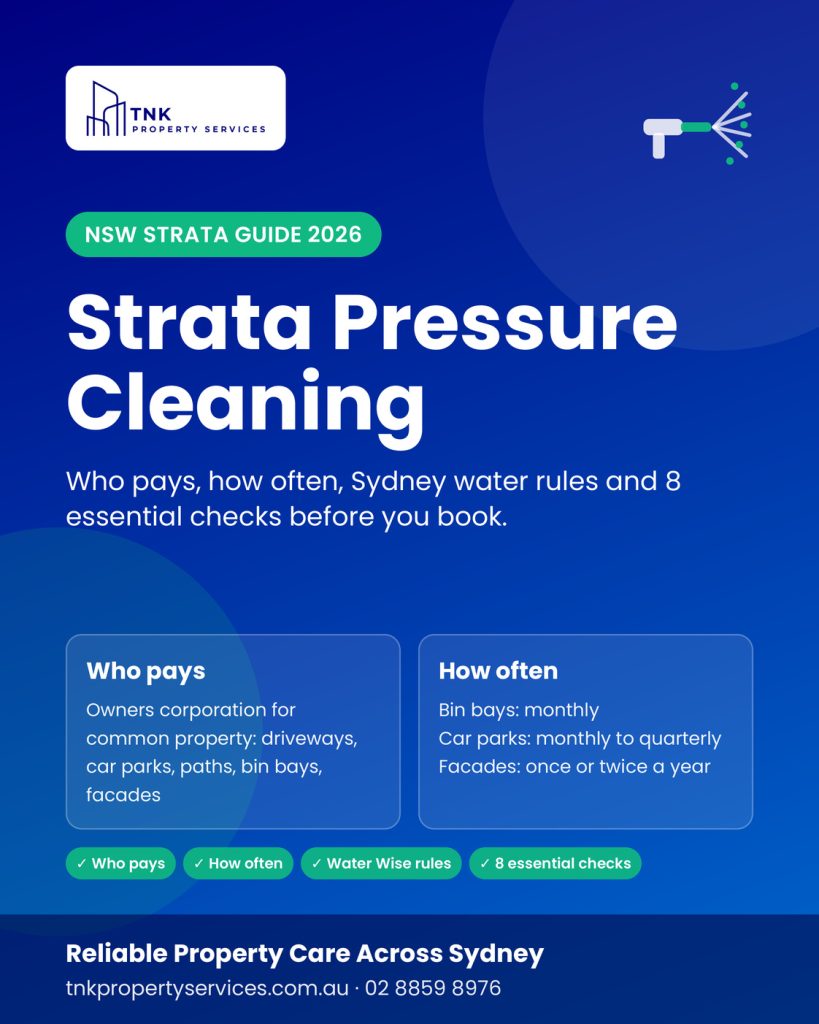
Quick answer: Strata pressure cleaning is the scheduled high-pressure washing of a building’s common property, such as driveways, car park ramps, entry paths, bin bays, pool surrounds and facades. In NSW the owners corporation pays for it from the administrative fund because it maintains common property, while owners usually clean surfaces inside their own lot. Most Sydney buildings pressure clean car parks and bin areas monthly to quarterly, and paths, pool areas and facades once or twice a year, using a contractor who follows Sydney Water’s Water Wise Guidelines and keeps wash water out of stormwater drains.
This guide explains who pays, how often to book each area, the water and pollution rules that apply in Sydney, and 8 essential checks to run before any contractor turns on a pressure washer at your building. It is written for strata managers, owners corporation committees, building managers and property managers.
We are TNK Property Services, a family-owned business based in Smithfield with more than 10 years looking after Sydney strata, commercial and mixed-use buildings. Pressure washing is part of the strata maintenance work we schedule for owners corporations every week.
In this guide
- What strata pressure cleaning covers
- Who pays for strata pressure cleaning in NSW?
- How often to book each area
- Sydney water and stormwater rules
- Safety risks committees should know
- 8 essential checks before you book
- What to put in the scope of works
- How TNK can help
- FAQs
What Strata Pressure Cleaning Covers
Regular sweeping and mopping keep a building tidy, but they do not lift ground-in grime. Oil drips in the car park, black mould on north-facing paths, chewing gum at the entry and sticky residue in the bin bay all need hot or high-pressure water and the right detergent. That is where strata pressure cleaning fits into your maintenance plan.
Typical common-property areas include:
- Driveways, ramps and car parks: oil and tyre marks, dust build-up, leaf stains and slippery patches.
- Entry paths, forecourts and stairs: mould, algae, gum and general foot-traffic grime.
- Bin bays and bin rooms: spills, odours and residue that attract pests.
- Pool surrounds and BBQ areas: slippery tiles, sunscreen, grease and algae.
- Facades, walls, awnings and fences: dirt, cobwebs, salt and pollution staining.
- Courtyards and common balconies that are shown as common property on the strata plan.
Strata pressure cleaning works best alongside your routine strata cleaning schedule, so the deep clean resets each area and the weekly clean keeps it that way. If you are building that schedule from scratch, our strata cleaning checklist lists common-area tasks and frequencies you can copy.
Who Pays for Strata Pressure Cleaning in NSW?
Under NSW strata law, the owners corporation must maintain and repair common property. The NSW Government’s strata repairs and maintenance guide confirms that the owners corporation plans and pays for common property work, while owners look after anything within their own property. Strata pressure cleaning of shared driveways, paths, car parks and facades is therefore a common expense, usually paid from the administrative fund.
| Area | Usually paid by | Notes |
|---|---|---|
| Shared driveways, ramps and car park aisles | Owners corporation | Common property in most schemes |
| Entry paths, forecourts, common stairs | Owners corporation | Often booked before the AGM or summer |
| Bin bays and bin rooms | Owners corporation | Health and pest control benefit for all residents |
| Pool surrounds and BBQ areas | Owners corporation | Slip risk makes this a safety item, not just presentation |
| External walls and facades | Owners corporation | May need work at height controls |
| Private courtyards and balconies inside a lot | Lot owner or occupier | Check the strata plan and any exclusive use by-laws |
| Individual garage spaces inside a lot | Lot owner | Some plans show car spaces as part of the lot |
Boundaries vary between schemes, so check your strata plan and by-laws before you book. An exclusive use by-law can hand a courtyard’s upkeep to one owner, even if the courtyard is common property. Where the owners corporation is responsible for a large program of works, remember the NSW rule that any work valued at $30,000 or more needs at least two independent quotes.
For a broader breakdown of who handles what, see our guide to strata repairs in NSW.
How Often Should You Book Strata Pressure Cleaning?
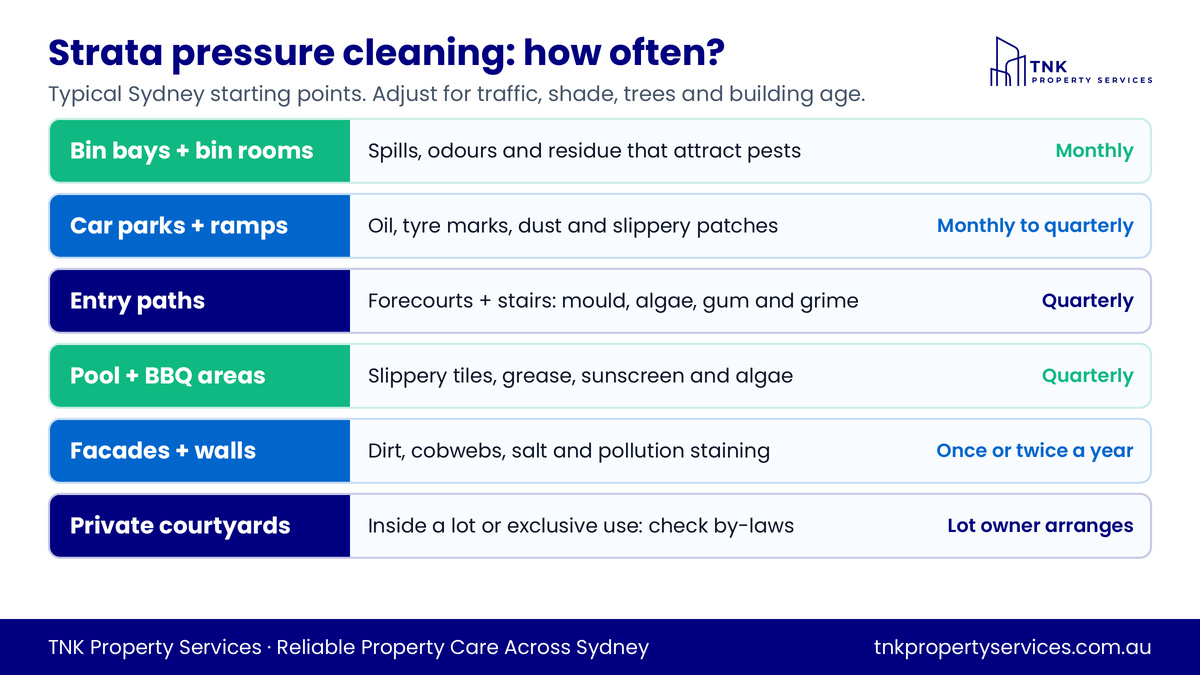
There is no legal frequency. The right cycle depends on traffic, shade, trees, building age and how close you are to the coast or a busy road. The table below gives typical starting points we see across Sydney buildings. Treat them as a guide, then adjust after the first clean.
| Area | Typical frequency | Book more often if |
|---|---|---|
| Bin bays and bin rooms | Monthly | Odours, pests or a large number of lots |
| Car parks, ramps and driveways | Monthly to quarterly | Oil leaks, heavy traffic or slippery ramps |
| Entry paths and forecourts | Quarterly | Shade, mould, gum or retail foot traffic |
| Pool surrounds and BBQ areas | Quarterly, plus before summer | Algae, heavy use or shaded tiles |
| Facades, walls and fences | Once or twice a year | Coastal salt, pollution or before painting |
Many committees time a full strata pressure cleaning round before the AGM, before the summer pool season, and after major works or storms. Pair it with your garden maintenance visits too. Gardeners clear leaf litter and trim plants away from paths first, so the wash lasts longer and mulch does not end up in the drains. Our strata garden maintenance guide covers how to plan those visits.
Signs your building is due for a clean
Do not wait for the next scheduled visit if you notice any of these:
- Green or black patches on shaded paths, stairs or pool tiles, which often mean algae or mould and a slip risk.
- Oil stains spreading across car park bays or ramps, or tyre marks on entry slopes.
- Persistent odours or flies around the bin bay, even after the bins are emptied.
- Dark streaks under window sills, balcony edges or awnings on the facade.
- Resident complaints about slippery surfaces, or a near miss reported to the strata manager.
Slip complaints deserve fast action, because the owners corporation must maintain common property, and a fall on a slippery path can quickly turn into an insurance claim.
Strata Pressure Cleaning Rules: Water and Stormwater in Sydney
Two sets of rules matter most for strata pressure cleaning in Greater Sydney: how drinking water may be used, and where the dirty water goes.
Sydney Water’s Water Wise Guidelines
Sydney Water’s Water Wise Guidelines apply to residents and businesses in Sydney, the Blue Mountains and the Illawarra. In short:
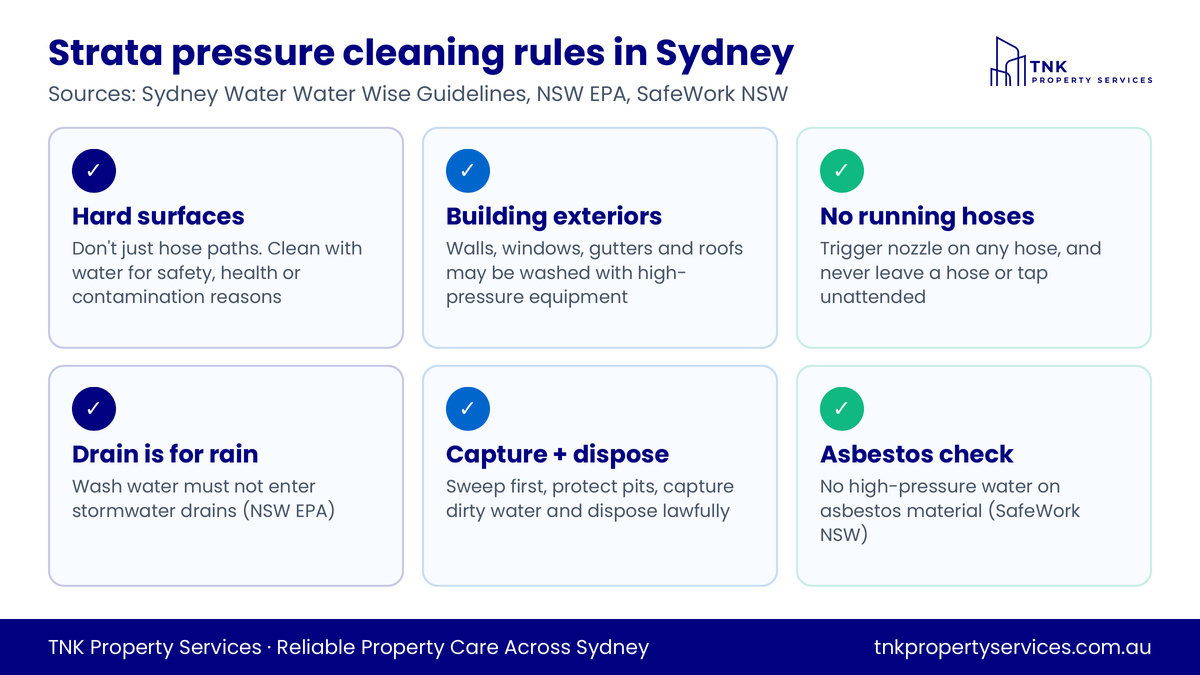
- Hard surfaces: you should not simply hose paths, driveways and paved areas. Cleaning them with water is allowed where it is needed for safety, health, emergency, construction or surface contamination reasons, and any hose must have a trigger nozzle unless it supplies high-pressure cleaning equipment.
- Buildings: washing building exteriors, including windows, walls, gutters and roofing, with a trigger-nozzle hose or high-pressure equipment is allowed.
- Taps and hoses: never leave a hose or tap running unattended.
In practice, oil stains, slippery algae and bin-bay residue are exactly the safety and contamination issues the guidelines allow for. Sweep or blow loose debris first, then use high-pressure equipment rather than an open hose.
Keep wash water out of the stormwater drain
Stormwater drains run straight to creeks, rivers and the harbour without treatment. The NSW EPA’s “the drain is just for rain” guidance says runoff from washing activities must not enter stormwater drains. Polluting waters is an offence under the Protection of the Environment Operations Act 1997, and fines can apply to the business that caused or allowed it.
Before strata pressure cleaning starts, ask your contractor how they will:
- Dry-sweep and remove solids, leaves and litter before washing.
- Block or protect stormwater pits near the work area.
- Capture or vacuum wash water from oily car parks and bin bays.
- Use biodegradable, low-phosphate detergents sparingly, or none at all where hot water does the job.
- Dispose of collected wastewater lawfully, for example to sewer under an approved trade waste arrangement.
Safety Risks Committees Should Know
Strata pressure cleaning uses powerful equipment, and a strata building is full of residents, children, pets and cars. The main risks are:
- Asbestos: SafeWork NSW lists high-pressure water spray as prohibited equipment on asbestos-containing material. Older roofs, eaves, fences and wall sheeting may contain asbestos, so check the building’s asbestos register or survey first.
- Injection and flying debris: a high-pressure jet can pierce skin and throw stones or loose grout.
- Slips: wet surfaces, detergent and moss make paths and ramps slippery during and after the clean.
- Electrical hazards: outdoor power points, lights, intercoms and gate motors must be protected from spray.
- Work at height: facades, awnings and upper walls may need elevated work platforms and a safe work method statement.
- Surface damage: too much pressure can etch concrete, strip sealers, open grout joints and damage render, timber and painted surfaces.
A good contractor sets up barriers and signs, works when foot traffic is low, and lets residents know in advance which areas and car spaces will be closed.
8 Essential Checks Before You Book Strata Pressure Cleaning
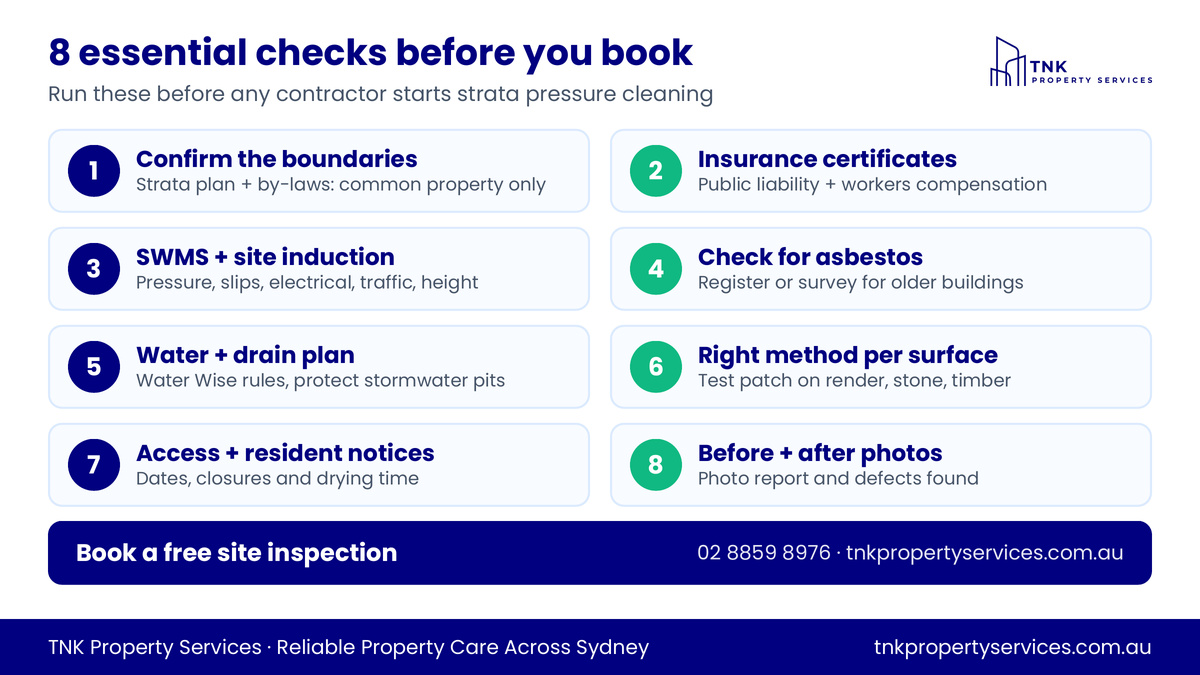
- Confirm the boundaries. Check the strata plan and by-laws so the quote only covers common property the owners corporation is responsible for.
- Ask for insurance certificates. Get current public liability and workers compensation certificates of currency before work starts.
- Request a SWMS and site induction. A safe work method statement should cover pressure, slips, electrical protection, traffic and any work at height.
- Check for asbestos. Ask the strata manager for the asbestos register or survey for older buildings, and exclude any suspect material from the scope.
- Agree the water and drain plan. The contractor should explain how they will follow the Water Wise Guidelines and keep wash water out of stormwater pits.
- Match the method to each surface. Concrete, pavers, sealed stone, render and timber each need different pressure, nozzles and detergents. Ask for a test patch on anything delicate.
- Plan access and notices. Agree dates, times, car park closures and resident notices at least a few days ahead, and allow time for surfaces to dry.
- Ask for before-and-after photos. A short photo report shows what was cleaned, flags damage or defects found, and makes the next committee meeting easier.
If you are comparing several providers, our strata cleaning tender pack includes a scorecard you can adapt for periodic services like this one.
What to Put in the Scope of Works
A clear strata pressure cleaning scope stops arguments about what was included. List each area, the surface type, the frequency, the method and any exclusions. For example:
| Scope item | What to specify |
|---|---|
| Areas and surfaces | Each area by name, surface type and approximate size, with a site map if possible |
| Method | Pressure range, hot or cold water, surface cleaner heads, detergents and spot treatments for oil or gum |
| Water and waste | Drain protection, wash water capture, disposal method |
| Timing | Days, hours, noise limits and car park or pool closures |
| Exclusions | Suspected asbestos, lot property, sealing or re-grouting unless quoted separately |
| Reporting | Before-and-after photos and a list of defects found, such as cracked pavers or lifting edges |
Strata pressure cleaning often shows up other jobs: lifting pavers, cracked concrete, blocked drains, failing sealant or loose handrails. Ask for these to be reported, then add them to your maintenance plan or building management defect log so they are fixed before they become claims. A building manager can coordinate that follow-up for the committee, as explained in what a building manager does.
The same scope approach works for other periodic services, such as common-area window cleaning after a facade wash, or carpet cleaning for lobbies and corridors that get dirt walked in from outside.
Mixed-use and commercial sites
In mixed-use buildings, the retail forecourt, loading dock or shop frontage may sit with a commercial lot or tenant rather than the owners corporation. Those areas are often covered by a separate commercial cleaning or office cleaning contract. Industrial sites have their own needs again, with degreasing and floor washing covered under warehouse cleaning. Make sure each contract says who washes which surface, so nothing is cleaned twice or missed.
How TNK Can Help
TNK looks after strata, commercial and mixed-use buildings across Greater Sydney with one local team and one point of contact. Our quality management system is certified to ISO 9001:2015 (JAS-ANZ accredited), our staff are police-checked and inducted on each site, and we report with checklists and photo reports. Our core services are:
- Building and facility management: inspections, contractor coordination, defect logs and reporting to the strata manager.
- Strata maintenance: pressure washing of driveways, paths, pool surrounds, bin bays and facades, plus handyman repairs and gutters.
- Strata cleaning: lobbies, lifts, corridors, bin rooms and car parks on a set schedule.
- Garden maintenance: lawns, hedges, garden beds and green-waste removal.
- Commercial cleaning: retail, medical, gym, school and warehouse sites under one documented scope.
- Office cleaning: schedules built around business hours for offices and commercial lots.
We carry $20 million public liability cover and supply certificates of currency, SWMS and induction records on request.
Planning strata pressure cleaning for your building? Book a free site inspection or call 02 8859 8976. We will walk the site, check surfaces and drains, and give you a clear written scope and quote.
Strata Pressure Cleaning FAQs
Who pays for strata pressure cleaning?
The owners corporation pays for pressure cleaning of common property, such as shared driveways, car parks, paths, bin bays and facades, usually from the administrative fund. Owners pay for areas inside their own lot, such as a private courtyard, unless the by-laws say otherwise.
How often should a strata car park be pressure cleaned?
Most Sydney buildings book car parks, ramps and driveways monthly to quarterly. Busy car parks, oil leaks or slippery ramps may need more frequent visits, while low-traffic sites can stretch to twice a year.
Is strata pressure cleaning allowed under Sydney Water’s rules?
Yes, with limits. The Water Wise Guidelines allow high-pressure cleaning of building exteriors, and cleaning hard surfaces with water where it is needed for safety, health, emergency, construction or surface contamination reasons. Simply hosing down paths is not allowed.
Can wash water go down the stormwater drain?
No. The NSW EPA says runoff from washing must not enter stormwater drains. Contractors should sweep first, protect drains and capture or lawfully dispose of dirty water.
Can you pressure clean an asbestos roof or fence?
No. SafeWork NSW prohibits high-pressure water on asbestos-containing material. Check the asbestos register or get a survey before cleaning older roofs, eaves, fences or wall sheeting.
Do residents need notice before strata pressure cleaning?
It is good practice to give residents notice of dates, times and any car park, pool or path closures. Your by-laws or strata manager may set a minimum notice period.
Will strata pressure cleaning damage pavers or render?
It can if the pressure or nozzle is wrong. A trained operator adjusts pressure for each surface, uses surface cleaner heads on flat areas, and tests delicate surfaces first.
This guide is general information only, current as at November 2026. Rules can change, and your building’s strata plan, by-laws and documents take priority. Check the linked NSW Government, Sydney Water, NSW EPA and SafeWork NSW sources or get professional advice for your scheme.